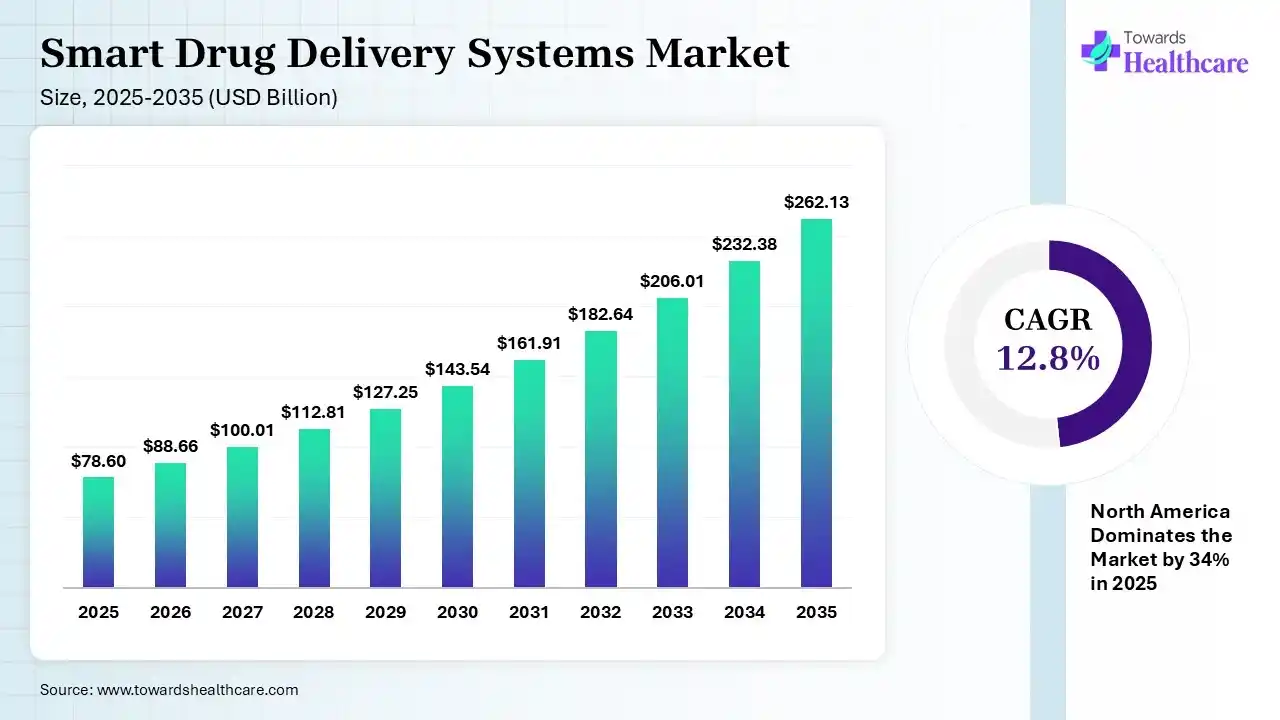
The global smart drug delivery systems market size was estimated at USD 78.6 billion in 2025 and is predicted to increase from USD 88.66 billion in 2026 to approximately USD 262.13 billion by 2035, expanding at a CAGR of 12.8% from 2026 to 2035. The growth in healthcare digitalization is increasing the adoption of smart drug delivery systems. Growing technological innovations, healthcare investments, a shift towards home healthcare, and new product launches are also enhancing the market growth.
The smart drug delivery systems market is driven by growing chronic disease burden and rapid advancements in digital health technologies. The smart drug delivery systems encompass advanced medical technologies developed for precise, controlled, or automated drug delivery. They help in providing targeted therapy, chronic disease management, real-time monitoring, and enhancing patient adherence to the treatment.
The use of AI in the smart drug delivery systems market is increasing as it helps in predicting optimal drug doses and analysing patient data. It also helps in treatment optimization, forecasting potential complications, and in the development of better drug delivery systems. It also helps in remote monitoring, where it offers reminders and alerts, which help in reducing irregular drug usage patterns.
Expanding Healthcare Digitalization
The growing healthcare digitalization is driving the adoption of smart drug delivery systems, promoting their integration with telehealth platforms, electronic health records, and mobile apps.
Shift Towards Home Healthcare
The rise in health awareness is increasing the adoption of home-based drug delivery systems like smart injectors, connected inhalers, and other wearable devices, with enhanced safety and effectiveness.
Escalating Technological Innovations
Growing technological advancements are driving the adoption of IoT, AI, and cloud-based analytics to accelerate the development of miniaturized, reliable, portable, and less intrusive devices.
| Table | Scope |
| Market Size in 2026 | USD 88.66 Billion |
| Projected Market Size in 2035 | USD 262.13 Billion |
| CAGR (2026 - 2035) | 12.8% |
| Leading Region | North America by 34% |
| Key Applications | Diabetes Management, Oncology, Autoimmune Diseases, Respiratory Disorders, Pain Management, Cardiovascular Diseases |
| Primary End Users | Hospitals, Specialty Clinics, Home Care Settings, Pharmaceutical Companies, Patients |
| Key Challenges | High device costs, regulatory complexity, cybersecurity risks, interoperability issues, reimbursement challenges |
| Measurable Values | USD Millions/Units/Volume |
| Market Segmentation | By Product Type, By Technology, By Route of Administration, By Application, By End User, By Distribution Channel, By Region |
| Top Key Players | Medtronic plc, Novo Nordisk A/S, Insulet Corporation, Becton, Dickinson and Company (BD), Baxter International Inc., Ypsomed Holding AG, Gerresheimer AG, West Pharmaceutical Services, Inc., Tandem Diabetes Care, Inc., Terumo Corporation |
| Segment | Share 2025 (%) |
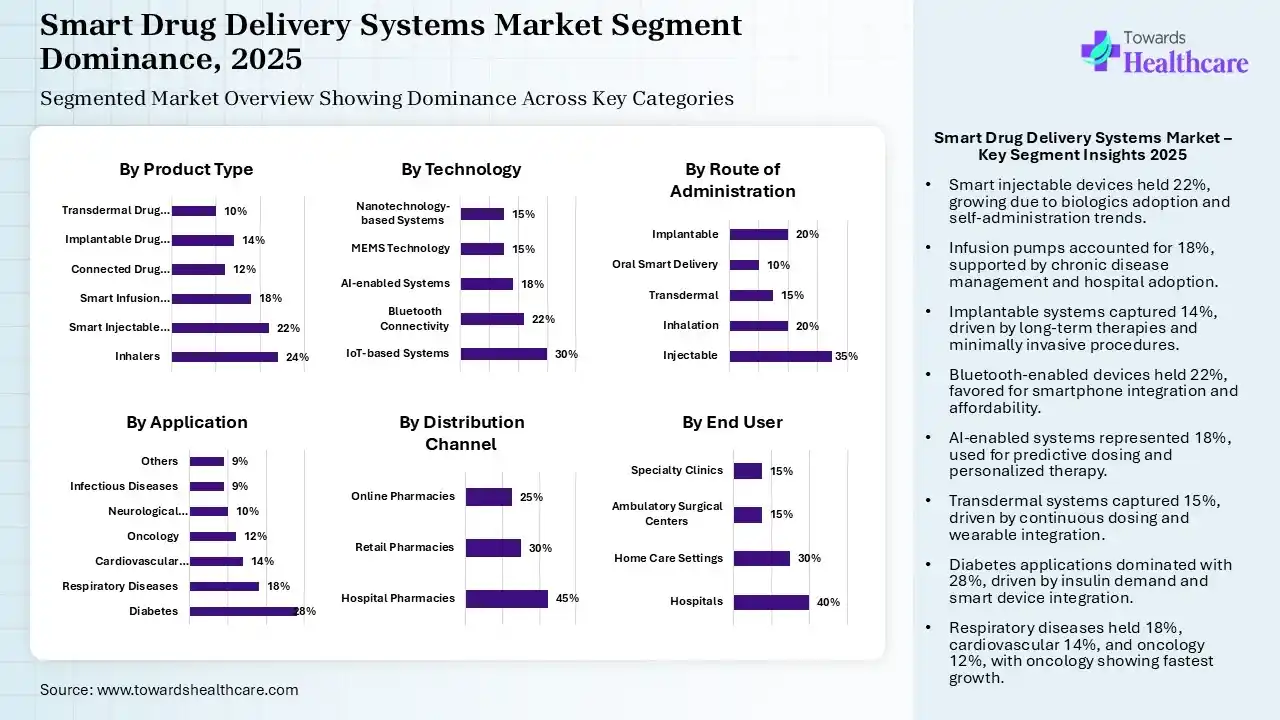
| Inhalers | 24% |
| Smart Injectable Devices | 22% |
| Smart Infusion Pumps | 18% |
| Connected Drug Delivery Devices | 12% |
| Implantable Drug Delivery Systems | 14% |
| Transdermal Drug Delivery Systems | 10% |
The Inhalers Segment Dominated the Market With 24% in 2025
The inhalers segment led the smart drug delivery systems market with 24% share in 2025, due to growth in the asthma and COPD cases. Their advanced features also promoted smart monitoring, which increased the adherence rates. Their integration with more apps also increased their use.
The smart injectable devices segment held the second-largest share of 22% of the market in 2025 and is expected to witness the fastest growth with a CAGR during the forecast period, due to growing biologics adoption. Expanding self-administration trends are also increasing their demand. Technological advancements are also driving their innovations.
The smart infusion pumps segment held 18% of the smart drug delivery systems market share in 2025, driven by growth in the chronic disease burden. Growing adoption of advanced pumps for accuracy and safety across hospitals is also increasing their demand. Increasing integration with EHR systems is also driving their use for patient monitoring.
The implantable drug delivery systems segment held 14% of the market share in 2025, due to increasing long-term drug release solutions. The growth in minimally invasive procedures is also driving their demand. The improved outcomes in chronic therapies are also increasing their adoption rates.
| Segment | Share 2025 (%) |
| IoT-based Systems | 30% |
| Bluetooth Connectivity | 22% |
| AI-enabled Systems | 18% |
| MEMS Technology | 15% |
| Nanotechnology-based Systems | 15% |
The IoT-based Systems Segment Dominated the Market With 30% in 2025
The IoT-based systems segment accounted for the highest revenue share of 30% of the smart drug delivery systems market in 2025, driven by healthcare digitization. They are also being used for remote monitoring applications. They also offered real-time data, which enhanced the treatment adherence.
The Bluetooth connectivity segment held the second-largest share of 22% of the market in 2025, due to its easy smartphone integration. They are also widely used in inhalers and injectables, where their affordability is also driving their adoption rates. Their wireless data transfer and user-friendly approaches are also increasing their demand.
The AI-enabled systems segment held 18% of the smart drug delivery systems market share in 2025, driven by their increased use in predictive dosing and personalized therapy. Their data analytics also help in enhancing the treatment outcomes. Additionally, growth in healthcare investments is also driving the adoption of new AI healthcare solutions.
The MEMS technology segment held 15% of the market share in 2025, due to its miniaturization, which helps in enhancing the device efficiency. The growing adoption of implantable and wearable devices is also increasing their demand. Moreover, their precise drug delivery control is also increasing their adoption rates.
| Segment | Share 2025 (%) |
| Injectable | 35% |
| Inhalation | 20% |
| Transdermal | 15% |
| Oral Smart Delivery | 10% |
| Implantable | 20% |
The Injectable Segment Dominated the Market With 35% in 2025
The injectable segment held a major revenue share of 35% of the smart drug delivery systems market in 2025, driven by their increased use in biologics and chronic therapies. Their precise dosing also improved the treatment adherence. The growth in the self-administration trends also increased their adoption rates.
The inhalation segment held 20% of the market share in 2025, due to growing respiratory diseases. This, in turn, is increasing the adoption of smart inhaler promoting medication tracking. Moreover, their growing integration with digital health platforms is also fuelling their growth.
The implantable segment held 20% of the smart drug delivery systems market share in 2025 and is expected to expand rapidly with a CAGR of 12.6% during the forecast period, due to its reduced dosing frequencies. The growing long-term therapies are also increasing their demand. Expanding minimally invasive techniques are also increasing their adoption.
The transdermal segment held 15% of the market share in 2025, driven by the continuous dosing. Additionally, growing demand for non-invasive drug delivery is also driving their adoption rates. The growth in wearable integration is also propelling their innovations.
| Segment | Share 2025 (%) |
| Diabetes | 28% |
| Respiratory Diseases | 18% |
| Cardiovascular Diseases | 14% |
| Oncology | 12% |
| Neurological Disorders | 10% |
| Infectious Diseases | 9% |
| Others | 9% |
The Diabetes Segment Dominated the Market With 28% in 2025
The diabetes segment contributed the biggest revenue share of 28% of the smart drug delivery systems market in 2025, due to growth in their incidence rates, which increased the demand for insulin delivery. This increased the adoption of smart pumps and injectors to improve glycemic control. Their continuous monitoring integration also contributed to their increased use.
The respiratory diseases segment held the second-largest share of 18% of the market in 2025, due to increasing asthma and COPD cases. This is increasing the adoption of smart inhalers, promoting their treatment adherence. Additionally, their expanding digital integration is also increasing their demand.
The cardiovascular diseases segment held 14% of the smart drug delivery systems market share in 2025, driven by the growing heart disease burden. This is increasing the demand for smart devices to reduce their further complications. This, in turn, is driving the adoption of implantable systems and continuous therapy solutions.
The oncology segment held 12% of the market share in 2025 and is expected to grow at the fastest CAGR during the predicted time, due to increasing cancer cases. The growing demand for target therapies is also driving the demand for advanced drug delivery systems. Additionally, growing advancements in nanotechnology are also enhancing their precision rates.
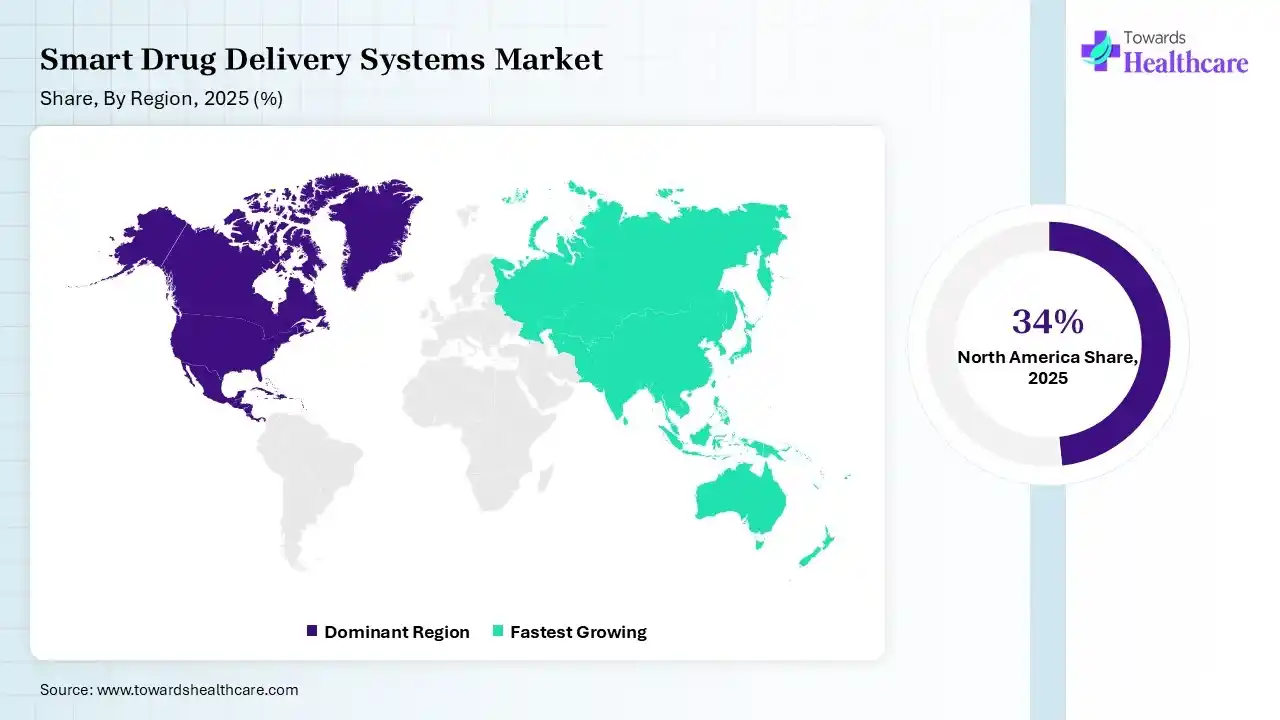
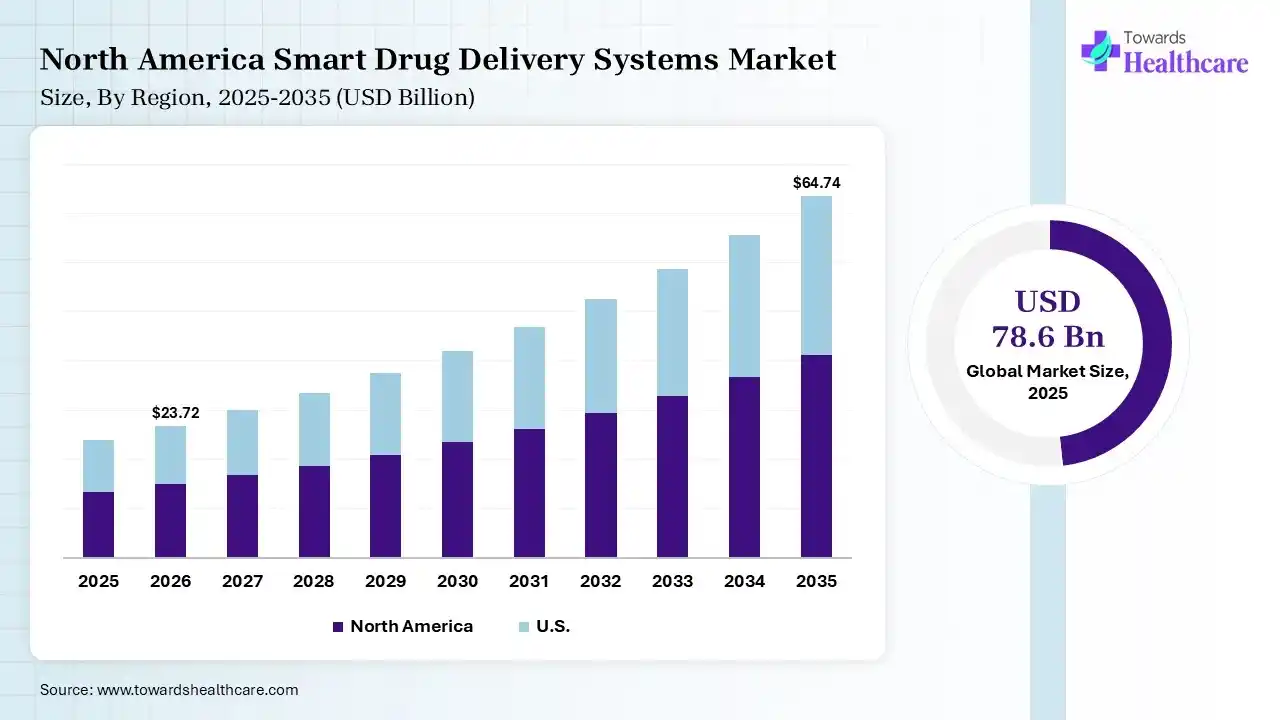
North America dominated the smart drug delivery systems market with 34% in 2025, due to the presence of advanced healthcare infrastructure. The growth in chronic disease burdens also increased the adoption of smart drug delivery systems. The presence of strong key market players also contributed to their increased innovation and adoption, which enhanced the market growth.
U.S. Market Trends
The presence of robust industries and advanced healthcare in the U.S. is driving the adoption of smart medical devices. The strong reimbursement policies are also enhancing their accessibility, supporting their increased usage. Additionally, increasing technological advancements are also driving their continuous innovations.
Asia Pacific held 26% of the smart drug delivery systems market share in 2025 and is expected to grow at the fastest CAGR during the forecast period, due to rapid healthcare expansion. The presence of a large patient population is also increasing the demand for smart drug delivery devices. Increasing investments in digital health are also accelerating their adoption rates, where government initiatives are also promoting the market growth.
India Market Trends
India is experiencing a rise in chronic diseases, which is driving the demand for smart drug delivery systems. Expanding healthcare access and digital healthcare are also driving their adoption. Additionally, the growing development of affordable smart devices and increasing government support are also propelling their innovations.
| Ecosystem Category | Key Participants | Role in Market |
| Technology Providers | Medtronic, Insulet, Ypsomed, Tandem Diabetes Care | Develop connected dosing algorithms, sensors, and smart delivery technologies |
| Product Manufacturers | BD, West Pharmaceutical Services, Novo Nordisk, Gerresheimer, SHL Medical | Manufacture smart injectors, wearable injectors, connected pens, infusion systems |
| Service Providers | Phillips-Medisize, Aptar Pharma, Nemera | Device engineering, product design, commercialization support |
| Platform Providers | Medtronic, Insulet, Novo Nordisk, Ypsomed | Digital health ecosystems connecting devices, apps, and cloud platforms |
| CROs/CDMOs | Phillips-Medisize, Stevanato Group, Nemera | Development and manufacturing support for pharmaceutical partners |
| Software Vendors | Medtronic, Insulet, ResMed, Adherium | Remote monitoring, adherence analytics, connected care software |
| Research Institutions | Massachusetts Institute of Technology (MIT), Harvard Medical School, Johns Hopkins University, Imperial College London | Smart delivery research, sensor development, AI-enabled dosing innovations |
| End-User Industries | Pharmaceuticals, Biotechnology, Hospitals, Home Healthcare, Specialty Clinics | Deployment and utilization of smart drug delivery technologies |
R&D
Clinical Trials and Regulatory Approvals
Packaging and Serialization
Distribution to Hospitals, Pharmacies
Patient Support and Services
| Tier 1 | Tier 2 | Tier 3 | |
| Typical Market Influence | 60% | 25% | 15% |
| Tier 1 | ||||
| Company Name | Headquarters | Country | Why Relevant to This Market | Key Products/Services |
| Medtronic | Dublin | Ireland | Global leader in connected insulin delivery and closed-loop systems | MiniMed 780G, InPen Smart Pen |
| Becton, Dickinson and Company | Franklin Lakes, New Jersey | USA | Broad smart injection and prefilled delivery portfolio | BD Intevia, Connected Injection Systems |
| Novo Nordisk | Bagsværd | Denmark | Major connected insulin pen ecosystem provider | Connected Pen Injectors |
| Tier 2 | ||||
| Company Name | Headquarters | Country | Why Relevant to This Market | Key Products/Services |
| Ypsomed | Burgdorf | Switzerland | Strong smart injector and connected delivery platform provider | SmartPilot, YpsoMate |
| Gerresheimer AG | Düsseldorf | Germany | Expanding connected drug-device portfolio | D-mine Pump, Gx SensAir |
| Baxter International | Deerfield, Illinois | USA | Smart infusion therapy solutions | Smart Infusion Pumps |
| Tier 3 | ||||
| Company Name | Headquarters | Country | Why Relevant to This Market | Key Products/Services |
| SHL Medical | Zug | Switzerland | Global autoinjector specialist expanding smart capabilities | Smart Autoinjectors, Pen Injectors |
| Aptar Pharma | Le Vaudreuil | France | Connected inhalation and injectable solutions | Digital Drug Delivery Platforms |
| Nemera | La Verpillière | France | Drug-device combination expertise | Smart Injection Devices |
Strengths
Weaknesses
Opportunities
Threats
By Product Type
By Technology
By Route of Administration
By Application
By End User
By Distribution Channel
By Region






Principal Consultant
Rohan Patil is a seasoned market research professional with over 5+ years of focused experience in the healthcare sector, bringing deep domain expertise, strategic foresight, and analytical precision to every project he undertakes.
Learn more about Rohan Patil

Reviewed By
Aditi Shivarkar is a seasoned professional with over 14 years of experience in healthcare market research. As a content reviewer, Aditi ensures the quality and accuracy of all market insights and data presented by the research team.
Learn more about Aditi Shivarkar