




 Request Consultation
At a Glance
As each stream of pharmaceuticals is expanding differently into 2027, a diverse group of ten therapeutic & modality segments ranging from precision oncology, genetic medicine, and metabolic disease is anticipated to surge at two to five times the rate of the expansive pharmaceutical market. Whereas the pharmaceutical market itself is growing at a comparatively modest 6.15% CAGR through 2035.
The respective briefing of ten areas focuses on predicted compound annual growth rate & investigates what is genuinely fueling each one. Among those ten areas, the bispecific antibodies in the US market are estimated to rise at 44.52% per year, approximately five times the growth rate of antibody-drug conjugates, the slowest-growing area still inside this top 10. Notable expansion of obesity drugs is being impelled by higher patient demand, while CAR-T and radioligand therapy are being spurred by clinical outcomes data. In addition, rare disease drugs are advancing by durable regulatory incentives, and next-generation antibody & RNA platforms are being encouraged by a combination of all three. From these areas, some of the areas are broadening from an actually small base, and manufacturing capacity, payer pushback, and clinical surging are all live risks to whether 2026's growth rates persist into the 2030s.
Specific Massive Surge: Bispecific Antibodies & Obesity Drugs Are Set to Outpace Other Therapeutic Areas
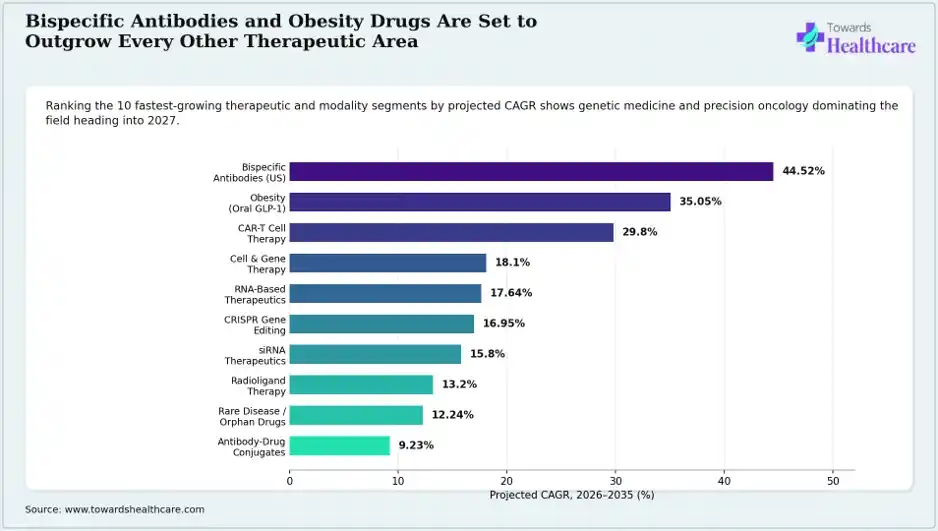
The chart displays a comparison among the forecasted 2026-2035 CAGR across ten therapeutic & modality segments, spanning antibody-drug conjugates at the low end (9.23%) to bispecific antibodies at the high end (44.52%).
This indicates roughly fivefold growth between the fastest (44.52%) and slowest (9.23%) areas across these ten areas. However, dual-targeting antibody platforms and next-generation obesity drugs are compounding at rates that will transform competitive reach within a few years, rather than a decade
Source: Towards Healthcare Database
In 2027, Bispecific Antibodies are Only Approaching as the Fastest-Growing Modality.
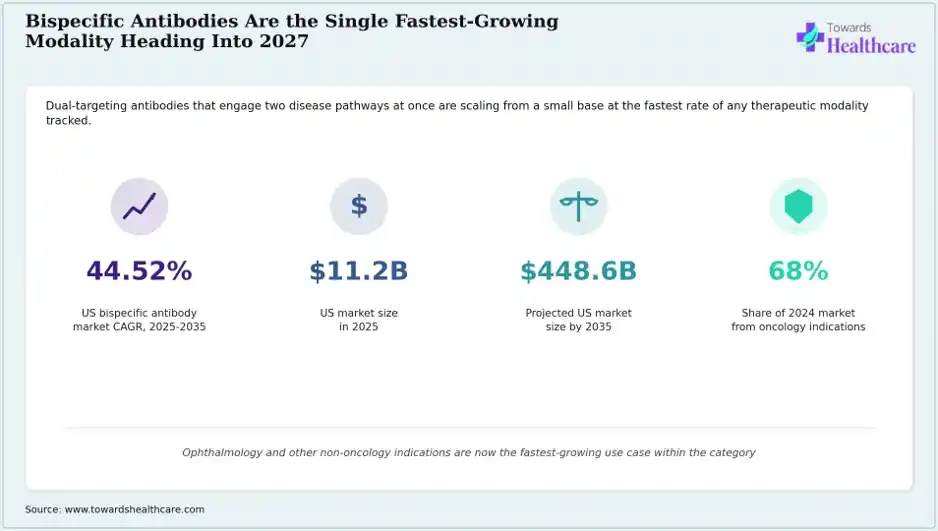
The statistics reflect the scale & expansion path of the U.S. bispecific antibody market, which encompasses engineering of antibodies to target two diseases at once.
Key Insights: Statistics show an impressive growth of the U.S. market from $11.2 billion in 2025 & anticipated to reach $448.6 billion by 2035. Alongside, bispecific antibodies are transitioning from an oncology-led category, i.e. with a 68% share in 2024, toward expansive application in ophthalmology & other non-oncology indications. As per evidence, the platform technology is verifying generalizability well beyond its original cancer applications.
Source: Towards Healthcare Database
Progression of Formulations: Oral GLP-1 Pills are Surging Two Times as Rapidly as Injectable Obesity Drugs
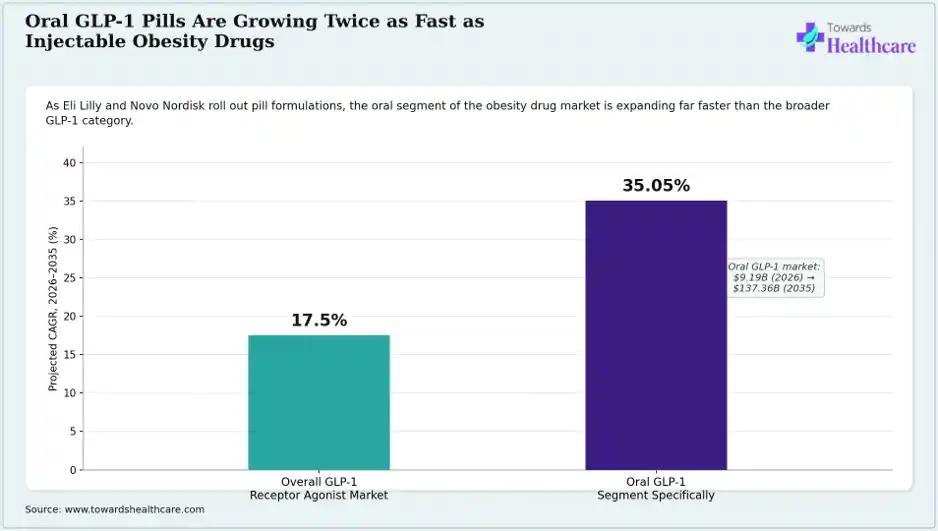
The infographic indicates a comparison of the predicted CAGR of the overall GLP-1 receptor agonist market (17.5%) against its oral-formulation subsegment (35.05%), coupled with the latest FDA approvals of pill-based weight management drugs.
Key Insight: The above CAGRs represent oral GLP-1 formulations, which are anticipated to expand at approximately twice the rate of the widespread injectable-dominated category. However, the industry’s upcoming competitive battlefield is moving from efficacy (already well-determined) to formulation convenience, which omits the injection hurdle presents to be uncovering a completely newer tier of patient demand.
Source: Towards Healthcare Database
Prospective Development: CAR-T Cell Therapy Stream is Expected to Broaden Roughly 12 Times Higher in the Coming Era
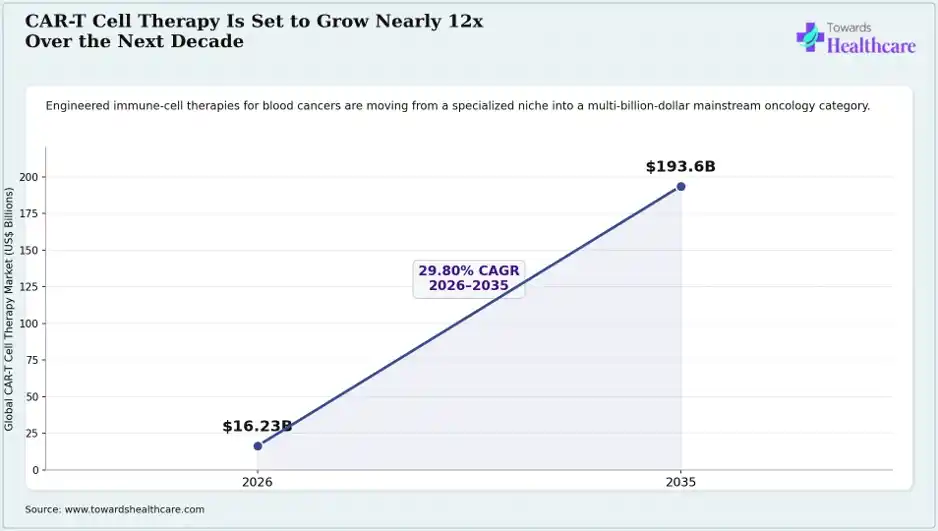
As per the analyst’s efforts, the line chart dictates the projected growth of the global CAR-T cell therapy market from 2026 to 2035, which is the third-fastest-growing area among these top ten areas.
Key Insight: The market is expected to reach nearly $16.23 billion in 2026 and approximately $193.6 billion by 2035, with an approximate 29.80% CAGR expansion. As a clinically validated therapy class, the category represents that CAR-Ts' expansion is being fueled by broadening indications & regional access, like Asia Pacific alone growing more than 20% CAGR, instead of volatile clinical results.
Source: Towards Healthcare Database
Exceeding Cell Therapy Over Gene Therapy, Along With Immense Scaling of Both Therapies at Double-Digit Rates
- Global cell & gene therapy market CAGR (2026-2035): 18.1%
- Share of the market from cell therapy vs. gene therapy (35%): 65%
- Share of the market from oncology indications: 39%
- Projected global market size by 2035: $47.18 billion
This segregation shows that currently cell therapy is registering nearly twice the market share of gene therapy, i.e. 65 % vs. 35%, while both streams are expanding at robust double-digit rates. Day by day, the balance between cell-based & gene-editing approaches is mainly influenced by heavy determination made by emerging clinical results.
Source: Towards Healthcare Database
Spotlighting RNA Segment: Collaboratively, mRNA & siRNA Lead to Roughly Two-Thirds of the RNA Therapeutics Market
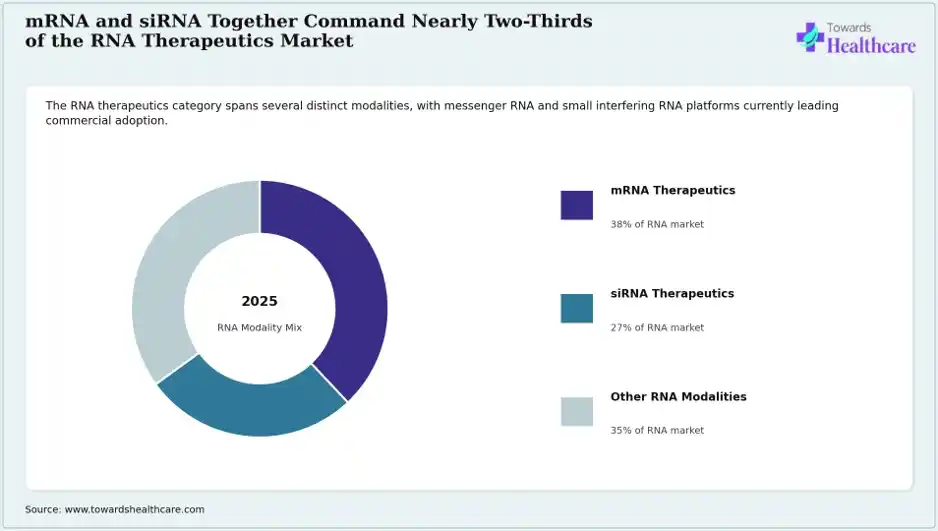
The chart explains the division of the RNA therapeutics market based on modality, where messenger RNA (mRNA) & small interfering RNA (siRNA) approaches are highlighted as the two vast segments.
Key Insight: These two dominating mRNA & siRNA segments show their massive, sophisticated manufacturing & delivery infrastructure as compared to other RNA modalities. Particularly, mRNA’s progression is primarily driven by pandemic-era vaccine scale-up, whereas siRNA’s development is spurred by validated GalNAc conjugate delivery technology, which resolved RNA’s historic delivery issue.
Remarkable Inclinations: CRISPR Gene Editing is Stepping From Lab Tool to In Vivo Treatment Platform
According to the analyst,
- Global genome editing market CAGR (2026-2035): 16.95%
- Market share held by ex vivo editing today: 52%
- CAGR of in vivo editing as the fastest-growing delivery method: 19.95%
Respective market shares of ex vivo editing & in vivo editing approaches highlight their corresponding growth rates.
Key Insight: Digits reflect that in vivo gene editing is rapidly growing at the highest CAGR, i.e. 19.95% vs. the ex vivo-led market average, along with a true manufacturing & expense benefit. Side by side, their approaches remove the need to extract, alter, & reinfuse a patient’s own cells, which eliminates one of the highly expansive & logistically intricate steps involved in the production of cell & gene therapy.
Source: Towards Healthcare Database
Notable Reinforcement: One Prostate Cancer Drug Category is Strengthening the Radioligand Therapy Thrive
Very firstly, targeted radioactive treatment provides delivery of radiation directly to cancer cells & these treatments are scaling expeditiously, with dominance of prostate-specific membrane antigen-targeted therapies.
As per analyst research activities,
- Global radioligand market CAGR (2025-2035): 13.2%
- CAGR of prostate cancer segment, i.e. the fastest-growing indication: 13.7%
- Forecasted global market size by 2035: $10.91B (higher than $3.15B in 2025)
This indicates prostate cancer as a rapidly growing segment compared to the category average, while radioligand therapy’s progression is focused risk as much as concentrated opportunity. Additionally, an extensive category’s near-term path is closely paired to isotope supply chains for Lutetium-177 and Actinium-225, a genuine physical constraint that no amount of clinical demand can skip.
More than Triple Growth of the Orphan Drug Market is Set by 2035
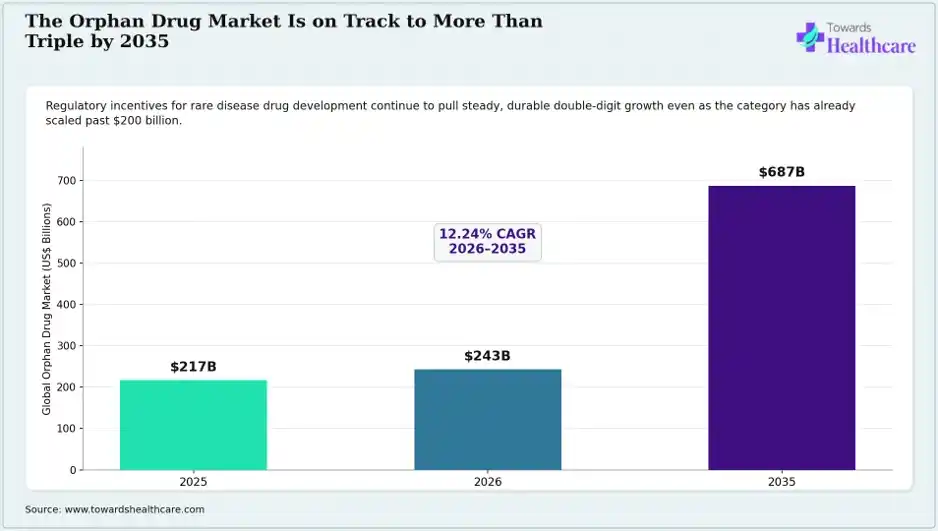
This graph reflects the projected growth of the global orphan drug market from its current scale ($200 billion) toward approximately $700 billion by 2035.
Key Insight: Regardless of scaling up in many therapeutic areas from a small foundation, orphan drugs are rolling with a vast, well-established category, which is still compounding over 12% per year. Evidence shows how durable regulatory encouragement consistently fosters sustained investment even in an already-expanded market.
Source: Towards Healthcare Database
Specifying Mainstream: Antibody-Drug Conjugates are the Slowest Growing Class Among the Top Ten Streams
Primarily, antibody-drug conjugates integrate an antibody, a linker, & a cytotoxic payload to transfer chemotherapy directly to cancer cells; this mechanism is currently validated across > 15 approved products.
Let’s have a look at the components involved in the ADCs:
- Antibody that targets a specific tumor cell marker, like HER2.
- Linker that joins the antibody to the payload and is stable in blood circulation.
- Cytotoxic Payload that is released inside tumor cell to destroy it.
Moreover, according to Towards Healthcare, ADC’s have a modest 9.23% CAGR & are still more rapid than the expansive pharmaceutical market’s 6.15%, but comparatively slower than other areas in these ten segments. As a mature category, a technology with 15+ approved products & well-recognized manufacturing has minimal room for the explosive expansion observed in truly developing modalities.
Source: Towards Healthcare Database
Execution of Four Forces that Clears the Reason Behind These Fastest-Growing 10 Areas than the Rest of Pharma
- Patent Cliff Replacement: This explains the replacement of novel modalities revenue lost to generics.
- Biomarker Precision: In such cases, genetic or molecular testing allows targeted pricing.
- Ageing & Chronic Disease: Globally increasing geriatric population & chronic disease result in demand for diverse therapies.
- Regulatory Incentives: Especially, orphan status and breakthrough designations speed up approval.
Furthermore, each area in this top 10 receives advantages from at least two of these four forces simultaneously. This further describes precisely why expansion here is systematic instead of speculative, & why these areas are the ones patent-exposed pharma firms are acquiring into, as noted in Parrell biotech M&A activity through 2026.
Source: Framework analysis synthesizing evidence from Sections 1-10 of this briefing.
Involvement of a Small Group of Leaders Spurs Simultaneous Growth Across Multiple Fast-Growing Areas
In this sector, despite each therapeutic area having different companies, many huge pharma & biotech leaders present as top firms across two or more of the fastest-growing streams.
- Novartis: This unveiled radioligand therapy called Pluvicto and CAR-T known as Kymriah
- Roche: A firm specializes in bispecific antibodies, ADCs, and retinal biologics.
- Eli Lilly/Novo Nordisk: They have explored obesity/GLP-1 unified with nearly 87% of prescription share.
- Gilead Sciences: It has unveiled CAR-T, i.e., Yescarta, along with modern cell and gene therapy manufacturing.
- AstraZeneca/Daiichi Sankyo: A key entity is ADC, i.e. Enhertu, and the radioligand pipeline is Fusion.
Key Insight: These companies are guiding in scaling advantages compound across adjacent modalities, such as manufacturing infrastructure, regulatory relationships, & capital developed for one fastest-growing platform, like Novartis’ radioligand manufacturing, which convey more easily into an adjacent one, such as CAR-T than into an irrelevant slow-growing class.
Source: Compiled from company product portfolios and public disclosures as referenced throughout this briefing.
Emergence of Three Forces Will Resolve Which of These Areas Continues Growth Beyond 2027
- Manufacturing Capacity: Isotope supply, cell therapy manufacturing, & biologics capacity are all restricted.
- Pricing & Reimbursement: Here, payers are now forcing back on GLP-1 and cell therapy costs at scale.
- Clinical Differentiation: Grouped categories, such as ADCs and bispecifics, will separate winners from me-too entrants.
Key Insight: Along with higher CAGR, current isotope and cell-therapy manufacturing constraints, payer pushback is already evident in GLP-1 & cell therapy pricing. However, immersive categories, such as ADCs & bispecific antibodies, are translating current growth rate into durable 2030s market leadership, which will be decided by implementation.
Source: Synthesis of evidence presented in Sections 1-12 of this briefing.
Recent Developments Across Top Ten Fastest-Growing Therapeutic Areas
In June 2026, Medicare unveiled an 18-month pilot program, ‘GLP-1 Bridge,’ that facilitates obesity medications, including Wegovy and Zepbound, at approximately $50 per month. It is recognized as the first major US federal reimbursement solution, especially for GLP-1 obesity indications. This will substantially broaden the massive patient population for GLP-1 drugs beyond current commercial-insurance-led access.
Source: Medicare.gov
In April 2026, Eli Lilly received U.S. FDA approval for orforglipron (Foundayo), an oral GLP-1 receptor agonist, for weight management in adults with obesity or overweight with comorbidities. It is the first oral small-molecule GLP-1, which differs from peptide-based oral semaglutide. This further expedites the oral GLP-1 segment’s already rapid growth pathway by overcoming manufacturing difficulties associated with peptide oral formulations.
Source: Eli Lilly and Company
In April 2026, Sidewinder Therapeutics closed a $137 million Series B round supported by OrbiMed and the Novartis Venture Fund to advance bispecific antibody-drug conjugates into clinical trials. This shows consistent venture capital confidence in next-generation combination modalities that consolidate bispecific and ADC mechanisms. This will impel upcoming efforts of innovation developing on top of two already fastest-growing classes.
Source: OpenPR, “Bispecific Antibodies Market to Reach $16.81 Billion by 2035,” May 2026.
In December 2025, India introduced its first indigenous CAR-T cell therapy, NexCAR19, designed by ImmunoACT targeting blood cancers. This has spanned CAR-T manufacturing and commercial capability over the conventional US/EU/Japan axis. In the future, this will bolster Asia Pacific’s anticipated 20%+ CAGR in CAR-T & will expand as the fastest-growing region for this category.
Source- ImmunoACT
Ongoing Funding, Collaborations & Launches Across Various Categories
In August 2026, Boulevard Bio launched with $65 million in aggregate financing from founding investor Deerfield Management to advance a multi-specific antibody pipeline for B cell-driven autoimmune disease.
Source- https://www.biopharminternational.com/view/boulevard-bio-launches-with-65-million-to-advance-multi-specific-antibody-pipeline-for-b-cell-driven-autoimmune-disease.
In August 2026, RiboX Therapeutics Ltd. received FDA clearance for the company's Investigational New Drug (IND) application for RXIM002, the world's first circular RNA-based in vivo CAR-T therapy delivered by a targeted lipid nanoparticle (tLNP) to treat autoimmune cytopenias.
Source- https://finance.yahoo.com/healthcare/articles/ribox-therapeutics-announces-fda-ind-074600038.html
In July 2026, Biocytogen and Whitehawk Therapeutics collaborated to evolve bispecific antibody-drug conjugates (BsADCs) that join Biocytogen's proprietary RenLite bispecific antibody discovery platform with Whitehawk's CPT113-based ADC linker-payload and bioconjugation technology.
Source- https://www.biopharminternational.com/view/biocytogen-and-whitehawk-therapeutics-partner-to-develop-bispecific-antibody-drug-conjugates-using-complementary-platform-technologies
In April 2026, Adcendo raised $75m in a Series C funding round to promote ongoing breakthroughs of its first-in-class and best-in-class ADC pipeline targeting cancers of high unmet medical need, such as further clinical development of three main programmes.
Source- https://www.pharmaceutical-technology.com/news/adcendo-75m-funding-adc-development/
In April 2026, Ferrosa Therapeutics AG announced seed financing of USD 3.5 million from founding investor Forty51 Ventures to reinforce a first-in-class bispecific antibody program for anaemia of inflammation.
Source- https://www.prnewswire.com/news-releases/ferrosa-therapeutics-announces-seed-financing-to-advance-a-first-in-class-bispecific-antibody-program-for-anemia-of-inflammation-302751617.html
Prospective Pipelines of Several Therapeutic Areas in 2027
Antibody-Drug Conjugates (ADCs):
- Genmab is inclining toward a 2027 commercial launch for Rinatabart Sesutecan (Rina-S), a FRα-targeted ADC in Phase 3 trials for ovarian and endometrial cancers.
- Numerous regulatory reviews for significant assets, such as Innovent's IBI343 and DualityBio's DB-1303, will set the baseline standard of care by 2027.
Bispecific Antibodies
- In 2027, multiple Phase 3 trial readouts will describe whether BCMA and GPRC5D-targeting bispecifics can officially replace standard chemotherapies in newly diagnosed multiple myeloma & follicular lymphoma.
- Genmab's multi-billion dollar asset Petosemtamab (Phase 3) is tracking for an expected product rollout in 2027.
Cell & Gene Therapy
- Topline Phase 3 data from the SUPRAME trial (Anzu-cel) is scheduled for H1 2027, with a BLA submission scheduled later in 2027.
- Wugen is moving toward a 2027 BLA submission following highly successful Phase 1/2 response rates.
- Upon its BLA in 2026, Lonvo-z is targeting commercial operations by 2027 for hereditary angioedema.
- Topline Phase 3 data of OCU400 (Ocugen) from the liMeliGhT trial is projected in Q1 2027, clearing the path for an expected 2027 FDA approval.
- Bota-vec (MeiraGTx) is seeking commercial launch, and Detalimogene is focusing on regulatory approval in 2027.
RNA Therapeutics
- Zeleciment Rostudirsen/DYNE-251, targeted exon-skipping therapy for Duchenne muscular dystrophy (DMD), has a rigorous FDA PDUFA target action date set for January 21, 2027.
- Following Phase 3 EMPEROR trial readouts of Zorevunersen, an experimental RNA antisense oligonucleotide (ASO) for Dravet syndrome, Stoke expects a rolling regulatory submission heading into 2027.
Key Companies & Organizations
| Company | Category | Specialization |
| Novartis (Headquartered in Basel, Switzerland & reported US$ 54.532 billion revenue in 2025) |
Diversified Pharma |
Along with its innovative CAR-T franchise called Kymriah and radioligand therapy (Pluvicto), they offer stronger new therapeutics aimed at cardiovascular, renal and metabolic, immunology, neuroscience, and oncology. |
| Roche/Genentech (Headquartered in Switzerland/ US, respectively and recorded nearly US$ 74.4 billion/US$57.7 billion, respectively) | Diversified Pharma | They have expanded their development significantly across bispecific antibodies, ADCs, and retinal biologics, with immense presence in rapidly growing oncology modalities. |
| Eli Lilly and Company (Headquartered in the US and generated net US$ 65.179 billion revenue in 2025) | Key Pharma/Obesity Leader | This company shows co-dominance in the obesity or GLP-1 market with orforglipron (oral) and tirzepatide, along with robust products, such as Mounjaro & Zepbound (tirzepatide), Humalog & Trulicity for diabetes and weight management, with oncology solutions, such as Verzenio. |
| Novo Nordisk (Headquartered in Denmark and reported 309.064 billion Danish kroner (DKK), i.e. roughly US$46.7 to US$46.9 billion in revenue in 2025) | Pharma/Obesity Leader | Along with its dominance in the obesity/GLP-1 market, it rolled out oral semaglutide (Wegovy pill), the first oral GLP-1 for weight management. |
| Gilead Sciences (Headquartered in the US and recorded roughly US$29.44 billion in revenue in 2025) | Cell Therapy/Manufacturing | They offer the CAR-T franchise (Yescarta), with flagship HIV treatments, such as Biktarvy, viral hepatitis therapies, including Epclusa, and oncology drugs like Trodelvy. |
| AstraZeneca/Daiichi Sankyo (Headquartered in the UK/Japan and reached revenue of JPY 698.4 billion/JPY 2,123.0 billion, respectively in 2025) | Oncology/ADC Leaders | Along with Enhertu & radioligand solutions, they also provide Datroway (datopotamab deruxtecan/Dato-DXd), a TROP2-directed ADC approved for specific hormone receptor (HR)-positive, HER2-negative metastatic breast cancer. |
| Alnylam Pharmaceuticals | RNA Therapeutics | This is an eminent siRNA therapeutics innovator, while Amvuttra reflects the commercial viability of infrequent-dosing RNAi drugs. |
| Moderna/Ionis (Headquartered in the US and recorded net revenue of US$1.944 billion/US$944 million, respectively in 2025) | RNA Therapeutics | They are leading firms in mRNA and antisense oligonucleotide platforms across the RNA-based therapeutics category. |
| Innovative Genomics Institute (UC Berkeley) | Gene Editing Research | This institute broadens CRISPR/Cas9 platform technology underlying much of the in vivo gene editing pipeline. |
| Daiichi Sankyo/Seagen (Pfizer) (Headquartered in Japan/US and reported revenue of nearly US$13.7 billion/US$62.0 billion (Pfizer), respectively in 2025) | ADC Developers | As the original pioneers, they are strengthening ADC technology through HER2 and other targeted programs. |
Strategic Business and Research Questions
- Which specific companies are best positioned to capture a disproportionate share within bispecific antibodies given the category's shift from oncology toward ophthalmology and other non-oncology indications?
- What is the realistic addressable patient population for oral GLP-1 drugs once price and access barriers are removed, compared to the currently reimbursed injectable population?
- How does isotope supply capacity for Lutetium-177 and Actinium-225 compare to projected radioligand therapy demand through 2030, and which companies have secured long-term supply agreements?
- Which mid-cap biotechs in the CAR-T space are the most likely acquisition targets for large pharma seeking to build allogeneic (off-the-shelf) capabilities?
- What is the realistic timeline for in vivo CRISPR gene editing to overtake ex vivo approaches in market share, and which specific delivery technologies are most likely to enable that shift?
- How does the actual real-world cost-per-patient for CAR-T therapy compare across academic medical centers versus community cancer treatment centers, and what does that imply for access equity?
- Which siRNA delivery platforms beyond GalNAc conjugates and lipid nanoparticles are furthest along in extending RNAi therapy beyond liver-targeted indications?
- What proportion of orphan drug approvals in 2026 targeted genuinely ultra-rare conditions under 5,000 patients versus larger rare-disease populations, and how does that affect pricing sustainability?
- Which specific ADC targets beyond HER2 and established indications have the strongest late-stage pipeline depth heading into 2027?
- How does the growth-rate premium for next-generation modalities, like bispecifics, CAR-T, radioligand, compare to the actual clinical outcomes improvement over prior-generation therapies in the same indications?
- What is the probability-adjusted risk that GLP-1 pricing pressure from Medicare's GLP-1 Bridge pilot compresses margins enough to slow the category's projected growth rate?
- Which companies have the strongest combined manufacturing capabilities spanning both cell therapy and gene therapy, positioning them to capture share regardless of which modality wins clinically?
- How concentrated is orphan drug pricing power among companies with multiple approved orphan products, and what does that mean for payer negotiating leverage over time?
- What is the realistic timeline for biosimilar or generic competition to enter any of these ten fastest-growing categories, and which are most exposed?
- Which Asia Pacific markets are best positioned to become genuine manufacturing and innovation hubs for CAR-T and cell therapy beyond simply lower-cost delivery of Western-developed products?
- How does venture capital allocation across these ten categories compare to their relative market size, and which areas show the most capital-to-opportunity mismatch?
- What is the realistic differentiation window before a crowded ADC or bispecific antibody pipeline compresses pricing power for later entrants in the same target class?
- Which specific regulatory pathway changes (beyond existing orphan drug incentives) are most likely to accelerate approval timelines for the remaining under-addressed rare disease indications?
- How does patient-reported outcomes data for oral versus injectable GLP-1 formulations compare on adherence, and what does that imply for long-term category share?
- What is the realistic probability that at least one of these ten fastest-growing areas experiences a significant growth-rate deceleration by 2028 due to manufacturing or reimbursement constraints identified in this briefing?
Data & Intelligence Pointers
- The US bispecific antibody market is projected to grow from $11.2 billion in 2025 to $448.62 billion by 2035, a 44.52% CAGR, the fastest of any therapeutic area tracked in this briefing.
- The oral GLP-1 market is forecasted to grow at 35.05% CAGR from 2026 to 2035, roughly double the 17.5% CAGR of the broader GLP-1 receptor agonist category.
- The global CAR-T cell therapy market is estimated to grow approximately 12x, from $16.23 billion in 2026 to $193.6 billion by 2035, a 29.80% CAGR.
- The global cell and gene therapy market is projected to account for $47.18 billion by 2035 at an 18.1% CAGR, with cell therapy holding roughly 65% of the market versus gene therapy's 35%.
- The RNA-based therapeutics market is predicted to expand at a 17.64% CAGR through 2034, with mRNA and siRNA together representing the majority of the category.
- The global genome editing market is projected to reach $52.56 billion by 2035 at a 16.95% CAGR, with in vivo delivery methods growing faster (19.95% CAGR) than the ex vivo approaches that still hold 52% market share.
- The radioligand therapy market is anticipated to surge from $3.15 billion in 2025 to $10.91 billion by 2035 (13.2% CAGR), led by prostate cancer indications increasing at 13.7% CAGR.
- The global orphan drug market is predicted to more than triple, from $216.66 billion in 2025 to $687.47 billion by 2035, a 12.24% CAGR.
- The global antibody-drug conjugate market is projected to grow from $13.51 billion in 2025 to $32.66 billion by 2035, a 9.23% CAGR, the slowest of the ten areas in this briefing, but still faster than the expansive pharmaceutical market's 6.15% CAGR.
- Eli Lilly and Novo Nordisk together hold roughly 87% combined prescription weight management drug revenue share in the obesity/GLP-1 market as of 2026.
- More than 15 antibody-drug conjugates have received global regulatory approval, with over 140 additional ADC molecules in active clinical development.
- The rare/orphan and gene therapies segment is expected to be the fastest-growing therapeutic area within the broader $3.22 trillion global pharmaceutical market expected by 2035.
References
- Towards Healthcare, “U.S. Bispecific Antibody Market to Worth USD 448.62 Billion by 2035.” December 3, 2025. Used for: US bispecific antibody market size and CAGR.
- Towards Healthcare, “Oral GLP-1 Market to Rise at 35.05% CAGR till 2035.” April 6, 2026. Used for: oral GLP-1 market size and CAGR.
- Towards Healthcare, “GLP-1 Receptor Agonist Market to Grow at 17.5% CAGR till 2035.” January 20, 2026. Used for: broader GLP-1 receptor agonist market figures.
- Towards Healthcare, “CAR T-Cell Therapies Market to Rise at 29.8% CAGR by 2035.” April 21, 2026. Used for: CAR-T cell therapy market size and growth trajectory.
- Towards Healthcare, “Cell and Gene Therapy Market to Rise USD 47.18 Bn by 2035.” 2026. Used for: cell and gene therapy market size, modality mix, and regional data.
- Towards Healthcare, “RNA Based Therapeutic Market Size Leads 17.64% CAGR by 2034.” November 1, 2025. Used for: RNA-based therapeutics CAGR figure.
- Towards Healthcare, “Genome Editing Market to Grow at 16.95% CAGR till 2035.” February 4, 2026. Used for: CRISPR/genome editing market size and in vivo/ex vivo split.
- Towards Healthcare, “Small Interfering RNA (siRNA) Market to Grow at 15.8% CAGR till 2035.” May 4, 2026. Used for: siRNA therapeutics market figures.
- Towards Healthcare, “Orphan Drug Market to Reach USD 687.47 Bn by 2035.” February 11, 2026. Used for: orphan drug market size and CAGR.
- Towards Healthcare, “Antibody Drug Conjugate Market Turns $13.51 Bn into a $32.66 Bn Opportunity by 2035.” April 28, 2026. Used for: ADC market size, CAGR, and mechanism description.
- Towards Healthcare, “North America Pharmaceutical Market Trends for 2026.” May 21, 2026. Used for: broader pharmaceutical market context and rare/orphan therapeutic area growth commentary.
- Precedence Research. “Pharmaceutical Market Size, Share and Trends 2026 to 2035.” June 23, 2026. Used for: global pharmaceutical market size and CAGR benchmark.