
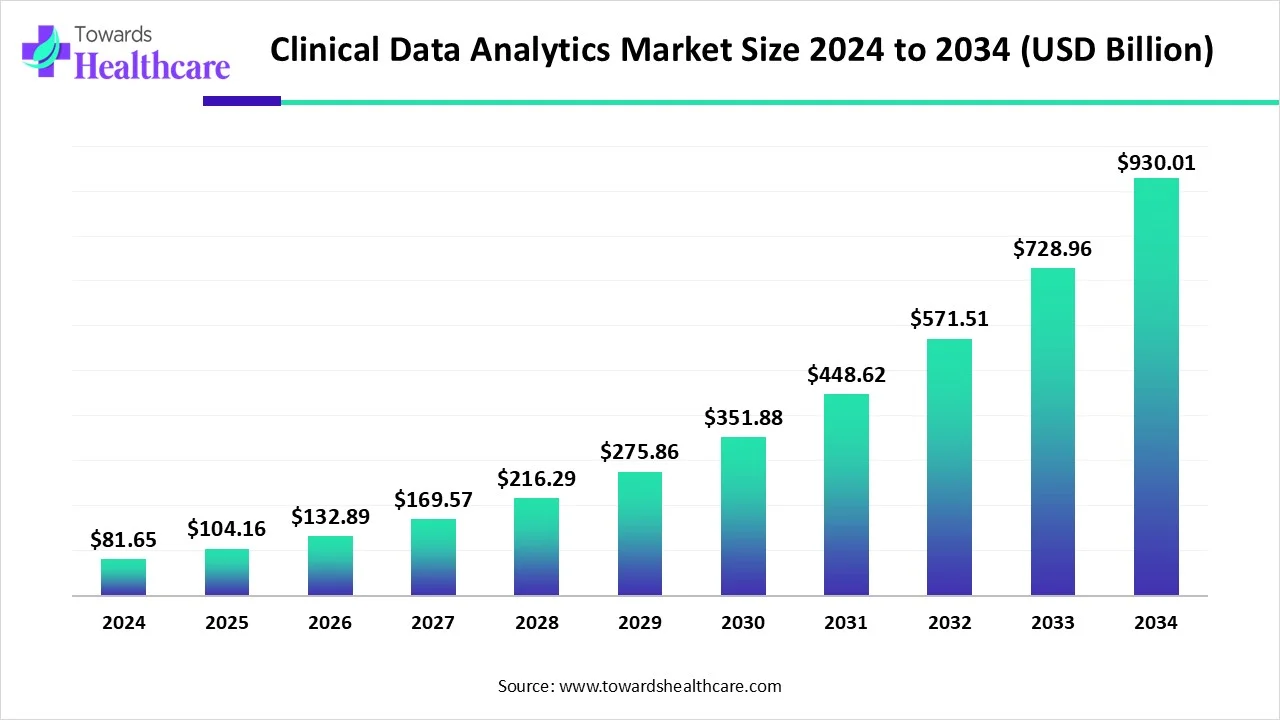
The global clinical data analytics market size is calculated at USD 104.16 billion in 2025, grew to USD 132.89 billion in 2026, and is projected to reach around USD 930.01 billion by 2034. The market is expanding at a CAGR of 27.57% between 2025 and 2034.
Clinical data analytics are solutions or services to verify complex healthcare protocols and improve their quality and efficiency. They perform internal and outsourced data management activities, monitor data usage in databases, and interpret data sets to optimize healthcare organizations’ workflow and practices. Clinical data analytics enable healthcare organizations to execute clinical trials, deploy data management, and run intelligent applications. Additionally, they can integrate healthcare data and other information from insurance claims data, health surveys, and patient monitoring devices.
The market is experiencing significant growth factors, such as the rising number of clinical trials and the growing demand for enhanced patient care. The increasing adoption of electronic health records (EHRs) and electronic medical records (EMRs) facilitates the use of clinical data analytics, as the volume of clinical data is steadily rising. The growing demand for personalized care also promotes the market. The advent of advanced technologies drives the latest innovations in clinical data analytics solutions. The market is also driven by growing research and development activities.
Artificial intelligence (AI) has the potential to fundamentally transform the practice of medicine and the delivery of healthcare. Integrating generative AI (GenAI) in clinical data analytics introduces automation and improves clinical data processing. It consolidates data, accelerates review, and reduces the overall time of analysis. The McKinsey Global Institute estimated that GenAI could generate $60 to $110 billion of economic benefits for the pharma and medical product-related industries. The advent of robotic automation and big data analytics can transform healthcare organizations and address governance policies. Natural language processing (NLP) and machine learning (ML) can analyze vast amounts of unstructured data like images, text, and human language. AI can also suggest treatment outcomes, preventing health risks and significant adverse effects.
Driver
Increasing Number of Clinical Trials
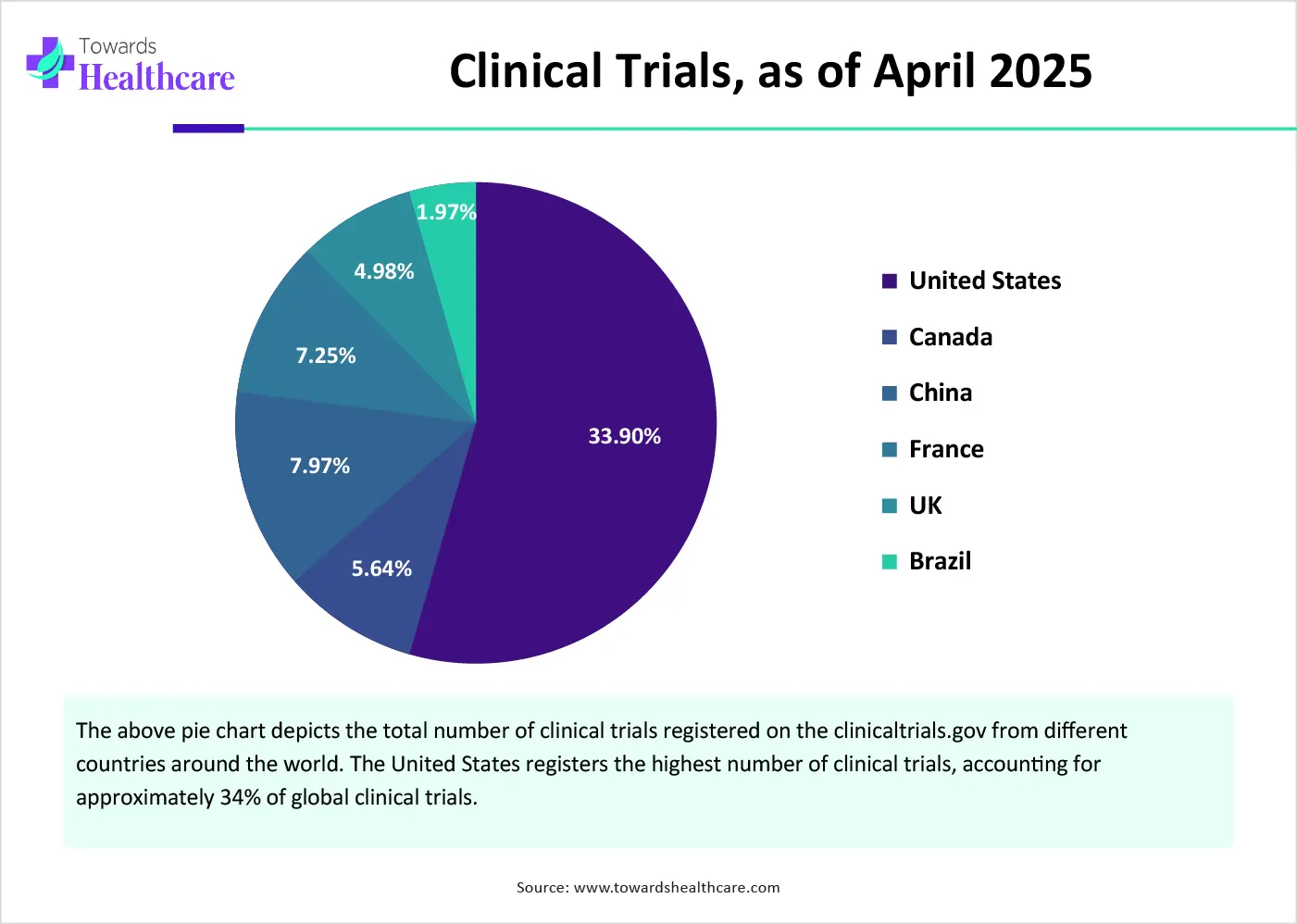
The growing research due to the rising prevalence of chronic disorders leads to increasing clinical trials. There are around 535,767 studies registered on the clinicaltrials.gov website as of April 2025. Clinical trials are essential to assess the safety and efficacy of novel drugs or medical devices. They are also performed to find extended applications of known marketed drugs. Regulatory agencies from numerous countries mandate clinical trial data before a product’s market approval. These trials generate large amounts of data, facilitating the use of clinical data analytics. Data analytics play a vital role in clinical trials by designing and analyzing trial data, expanding patient selection criteria, and drawing conclusions from the outcomes.
Restraint
Interoperability Issues
The major challenge of the clinical data analytics market is the interoperability issues. It is difficult to achieve seamless communication between different healthcare systems, causing an effective barrier in the implementation of data analytics. These issues also occur due to organizational barriers, such as resistance to change and inadequate investment in training and resources.
Opportunity
Patient-Centric Care
Patient-centric care is a healthcare approach for treating a patient with dignity and respect, and involving them in clinical decisions. It focuses on creating individualized treatment plans, encouraging collaborative decision-making, building patient-physician relationships, and facilitating internal information sharing. These approaches enable healthcare professionals to pay better attention to a patient’s health and well-being, improving treatment outcomes. Patient-centric care also eliminates the need for unnecessary tests and hospital referrals. Several government organizations launch initiatives to promote patient-centric care in their respective nations. Thus, this potentiates the need for clinical data analytics, enabling effective clinical decision-making.
| Metric | Details |
| Market Size in 2025 | USD 104.16 Billion |
| Projected Market Size in 2034 | USD 930.01 Billion |
| CAGR (2025 - 2034) | 27.57% |
| Leading Region | North America |
| Market Segmentation | By Deployment Model, By Organization Size, By End-User, By Region |
| Top Key Players | Brightinsight, Inc., Clario, eClinical Solutions LLC, IBM Corporation, Innovaccer, McKesson Corporation, MedeAnalytics, Inc., MultiPlan Corporation, Oracle, Royal Philips, Synapxe, Veradigm |
By deployment model, the cloud segment held a dominant presence in the clinical data analytics market in 2025. Cloud technology enables healthcare professionals to store and share large amounts of structured and unstructured data. It can be operated from anywhere and at any time through different devices. It simplifies data management and provides real-time insights into clinical trial data, facilitating faster clinical decision-making. On average, a hospital generates approximately 50 petabytes of data annually. Hence, cloud-based solutions provide insights into complex data and facilitate increased collaboration among healthcare professionals.
By deployment model, the on-premise segment is predicted to witness significant growth in the market over the forecast period. On-premise data analytics solutions enable healthcare professionals and other associated staff to have complete control over the data. They maintain privacy within the organization and eliminate the risk of security breaches and cyberattacks. The increasing investments and the availability of suitable infrastructure favor the installation of an on-premise system, boosting the segment’s growth.
By organization size, the large enterprises segment held the largest share of the clinical data analytics market in 2025. Large enterprises of the healthcare sector include pharmaceutical giants, insurance providers, and healthcare system operators. These enterprises account for the major share of healthcare operations globally. They generate large amounts of data and require accurate analysis of the generated data. The presence of favorable infrastructure and suitable capital investments facilitates them to adopt advanced data analytics solutions.
By organization size, the small and medium enterprises (SMEs) segment is anticipated to show lucrative growth in the market over the studied period. The increasing number of healthcare startups and the rising venture capital investments augment the segment’s growth. The World Intellectual Property Organization (WIPO) reported that SMEs account for approximately 90% of businesses worldwide and contribute over 50% of employment, holding a significant position in the global economic landscape. The growing research and development activities in such organizations necessitate clinical data analytics.
By end-user, the pharmaceutical & life sciences segment led the global clinical data analytics market in 2025. The growing research activities related to drug discovery, genomics & proteomics, and stem cells, as well as the increasing number of clinical trials, foster the segment’s growth. By leveraging advanced clinical data analytics enable pharmaceutical and life science companies to stay ahead in the competitive market and strengthen their position as global leaders. Data analytics leads to faster results, reducing the time to market of novel products.
By end-user, the public health & government segment is projected to expand significantly in the market in the coming years. Public health organizations use large databases to spot epidemiological patterns, predict disease outbreaks, and allocate resources efficiently, thereby improving public health responsiveness. Data analytics in public health enhances accuracy, effectiveness, and inclusion. This enables healthcare professionals to adjust their strategy based on patients’ requirements. The growing demand for patient-centric care and personalized treatment propels the segment’s growth.
North America dominated the global clinical data analytics market in 2025. The growing demand for personalized care and robust healthcare infrastructure drives the market. Favorable government support and increasing investments promote the adoption of clinical data analytics in life sciences and healthcare organizations. The presence of key players, such as IBM Corporation, Clario, and POTLOC, holds a major share of the market in North America. The rising need for enhanced patient care and the growing use of EHRs propel the market.
U.S. Market Trends
The increasing number of clinical trials facilitates the use of clinical data analytics. The U.S. conducts the highest number of clinical trials globally, accounting for 181,659 studies registered on the clinicaltrials.gov website as of April 2025. Additionally, more than 96% of non-federal acute care hospitals have a certified EHR.
Canada Market Trends
Canada was ranked fourth for the total number of active clinical trials in 2025. The Canadian Institutes of Health Research (CIHR) provides $1 billion annually for health research. The government aims to position Canada as a global hub for clinical research. MEDITECH is the largest provider of EHR systems in Canadian hospitals, with 165 installations and a 29.7% market share as of 2023.
Asia-Pacific is projected to host the fastest-growing clinical data analytics market in the coming years. The increasing number of healthcare startups and growing research and development activities favor the use of clinical data analytics. The rising adoption of advanced technologies and the burgeoning healthcare sector contribute to market growth. Several venture capitalists invest in Asia-Pacific countries due to their rapidly expanding healthcare infrastructure and affordable treatment. Several government organizations support research and clinical trials, boosting market growth.
Japan Market Trends
The Government of Japan actively promotes the adoption and interoperability of EMRs to accelerate healthcare digitization through its “Medical Digital Transformation Promotion Plan” initiative. The government also provides subsidies to support the nationwide sharing of medical information.
India Market Trends
There are more than 12,500 HealthTech startups in India, including 1,530 funded companies that collectively raised approximately $11.4 billion in venture capital investment and private equity. Moreover, India received the highest private equity investment in the healthcare sector in Asia-Pacific during 2024.
Europe is expected to grow at a notable rate in the clinical data analytics market in the foreseeable future. Favorable government policies support digital healthcare in Europe. The stringent data protection regulations and state-of-the-art research and development facilities foster the market. The rapidly expanding healthcare sector and the increasing number of clinical trials contribute to the market. The increasing investments, collaborations, and mergers & acquisitions contribute to market growth.
UK Market Trends
The UK registered 26,695 clinical trials on the clinicaltrials.gov website as of April 2025. The Medicines and Healthcare products Regulatory Agency (MHRA) makes constant efforts to build upon the country’s world-leading clinical research and create a favorable regulatory framework. The MHRA also collaborates with numerous life science companies to increase research and streamline approvals. Additionally, it is estimated that around 47% of the healthcare organizations in the UK use predictive analytics.
Germany Market Trends
Germany’s clinical data analytics market is steadily expanding as hospitals adopt digital records and data-based care. Strong healthcare infrastructure supports wider use of analytics for clinical decisions, quality improvement, and patient outcomes. Future opportunities include predictive tools, interoperability, and precision medicine. Competition remains active, with Siemens Healthineers, Oracle, IQVIA, and other major technology providers offering analytics platforms and services.
Latin America’s clinical data analytics market is expected to grow at a significant pace during the forecast period as healthcare systems move toward digital records and better data use. Brazil leads regional activity, while other countries are improving health IT. Growing chronic disease needs create demand for clinical decision tools. Future opportunities include cloud platforms and population health analytics. Competition includes global technology firms and regional healthcare software providers.
Brazil Market Trends
Brazil has strong growth potential for the clinical data analytics market because healthcare providers are investing in digital systems and better patient data management. Hospitals and payers are seeking tools for clinical decisions, quality improvement, and population health. More cloud use can support future growth. Competition includes companies such as Philips, GE HealthCare, Siemens Healthineers, and local health technology firms.
Argentina Market Trends
Argentina’s clinical data analytics market is developing as healthcare organizations increase digital adoption and seek better use of patient data. Clinical decision support and population health tools offer room for growth. Demand should rise as providers focus on efficiency and chronic disease management. Future opportunities include cloud analytics and connected systems. Competition comes from international vendors and local healthcare technology companies.
Middle East and Africa is expected to grow significantly during the forecast period. The MEA clinical data analytics market is seeing more interest as governments and healthcare providers push digital transformation. The UAE and Saudi Arabia are investing in smart healthcare and data-driven systems. Hospitals need analytics for better decisions, quality, and population health management. Future opportunities include cloud platforms and predictive tools. Competition includes global technology companies alongside regional digital health providers.
UAE Market Trends
The UAE clinical data analytics market is supported by strong digital programs and investment in smart hospitals. Providers are using data to improve clinical decisions, patient outcomes, and service planning. Cloud-based systems offer further opportunity as providers modernize. Competition is growing among global technology firms and regional digital health companies. Demand should remain strong as healthcare becomes more connected and increasingly digital.
Saudi Arabia Market Trends
Saudi Arabia’s clinical data analytics market is gaining momentum through healthcare modernization and digital transformation programs. Providers are looking for analytics that support clinical decisions, patient management, and operational planning. Large healthcare networks create opportunities for integrated data platforms. Future growth can come from cloud adoption and population health tools. Competition includes international analytics companies and regional healthcare technology providers.
In July 2026, “We've listened to our customers, and they're clear that AI can transform clinical trials, but not as an army of agents from disparate sources trained in disparate ways," said Anthony Costello, CEO, Medidata. "Medidata Plus is a drop-in AI strategy for clinical research that upskills teams, automates workflows, and surfaces insights at a pace that's redefining what teams thought was possible. We are in conversations with dozens of customers about making this shift, and what we're hearing tells us the industry has been waiting for exactly this.”
By Deployment Model
By Organization Size
By End-User
By Region