
Towards Healthcare Research & Consulting

U.S. 503B Compounding Pharmacies Market Size, Trends and Forecast 2035

U.S. 503B Compounding Pharmacies Market ( By Product Type: Sterile Compounded Drugs, Non-sterile Compounded Drugs; By Formulation Type: Injections & Infusions, Solutions, Suspensions, Creams & Gels, Capsules & Tablets; By Therapeutic Application: Pain Management, Hormone Replacement Therapy, Oncology, Ophthalmology, Infectious Disease Treatment, Cardiology, Gastroenterology, Nutritional Infusions, Pediatrics, Dermatology; By Compounding Type: Batch Compounding, Patient-specific Compounding) U.S. Analysis by Product Type, Formulation Type, Therapeutic Application, Compounding Type, Company Landscape and Forecast 2026–2035.

Last updated 7 October 2026   |   Primary source: Towards Healthcare   |   Report: 5180   |   Derived values are labelled
USD 1.25 Billion
Revenue, 2025
USD 2.61 Billion
Forecast, 2035
7.63%
CAGR, 2025-2035
United States
Report Coverage

The U.S. 503B compounding pharmacies market size is projected to grow to 1.35 billion in 2026. Forecasts suggest it will reach approximately US$ 2.61 billion by 2035, registering a CAGR of 7.63% during the period.
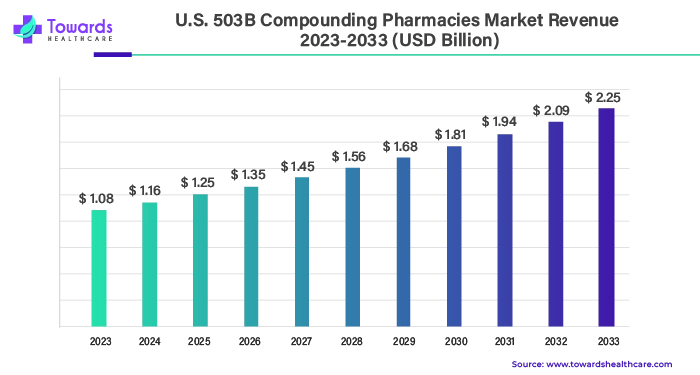
503B Compounding Pharmacies Market Revenue 2025 - 2034

Key Takeaways

  • U.S. 503B compounding pharmacies industry poised to reach USD 1.35 billion by 2026.
  • Forecasted to grow to USD 2.61 billion by 2035.
  • Expected to maintain a CAGR of 7.63% from 2026 to 2035.
  • The Northeast region accounted for the largest regional revenue share in 2025.
  • The South region is expected to witness the fastest growth during the predicted timeframe.
  • By product type, the sterile compounded drugs segment dominated the market by 68% in 2025.
  • By product type, the non-sterile compounded drugs segment is expected to show the fastest growth in the forecast period.
  • By formulation type, the injections & infusions segment accounted for the highest revenue share of the U.S. 503B compounding pharmacies market by 38% in 2025.
  • By formulation type, the capsules & tablets segment is expected to grow at the fastest CAGR in the market during the forecast period.
  • By therapeutic application, the pain management segment led the market by 24%  in 2025.
  • By therapeutic application, the oncology segment is expected to grow with the highest CAGR in the market during the studied years.
  • By compounding type, the batch compounding segment registered its dominance over the global market by 64% in 2025.
  • By compounding type, the patient-specific compounding segment is projected to expand significantly in the market in the coming years.

What Are 503B Compounding Pharmacies?

503B compounding pharmacies are FDA-regulated facilities permitted to produce sterile medications in bulk,  unlike traditional 503A pharmacies that can only compound drugs based on individual prescriptions. These pharmacies adhere to Current Good Manufacturing Practices (CGMP) and are routinely inspected by the FDA, ensuring the highest quality and safety standards.

But what sets them apart is their ability to produce and stock ready-to-use, sterile injectables,  medications that are vital for emergency rooms, intensive care units, and high-demand clinical environments.

503B Compounding Pharmacies Market Trends

Expanding industries: To accelerate the development of compounded drugs, the industries are increasingly investing in the 503B compounding pharmacies. Moreover, new acquisitions are also contributing to the same, leading to the expansion of the industries. Moreover, new guidelines are also being provided to support the development of the drugs in these pharmacies.

For instance,

  • In January 2025, guidance on compounding with the use of bulk drug substances was released by the FDA for 503B outsourcing facilities and 503A pharmacies. The outsourcing facilities and pharmacies using certain types of bulk drug substances will be supported and protected by this guidance, as well as the lists of products that can be used in drug compounding will also be reviewed by the FDA.
  • In January 2025, the acquisition of AleraCare Pharmacy’s compounding pharmacy operations was announced by Revelation Pharma, which is a national network of 503A and 503B compounding pharmacies. These operations will be rebranded as OmniScript Compounding, and the staff will not be changed.

Why the Demand Is Skyrocketing

Rise in Sterile Injectable Usage

With a surge in infectious diseases, chronic conditions, and emergency care needs, the use of sterile injectables has witnessed a major spike. These drugs are critical in ICUs, ERs, and surgical centers, especially for:

  • Pain management
  • Antibiotics and antivirals
  • Sedatives and anesthetics
  • Electrolyte replacement therapies

According to healthcare data, a separate global sterile injectable drugs forecast estimates a 7.4% CAGR from 2025 to 2032; this broader pharmaceutical category should not be treated as a direct forecast for the U.S. 503B segment, giving 503B pharmacies a potential for capacity expansion to scale.

AI Integration is Enhancing Accuracy

Artificial Intelligence is reshaping the pharmaceutical world and 503B pharmacies are no exception. AI is now used to:

  • Monitor compounding processes in real-time
  • Detect anomalies in documentation and ensure regulatory compliance
  • Automate batch production for sterile injectables
  • Minimize contamination risk by reducing manual handling

In fact, facilities leveraging AI in compounding have reported up to a 40% reduction in errors and significantly faster turnaround times.

Solving the Drug Shortage Crisis

Global drug shortages are at an all-time high, with over 300 medications listed as in short supply in the U.S. alone (FDA, 2025). Hospitals are increasingly relying on 503B compounding pharmacies to fill this critical gap.

By producing essential sterile medications in advance and at scale, 503B facilities are helping healthcare providers avoid treatment delays, ultimately improving patient outcomes.

FDA Guidance Fuels Innovation

In January 2025, FDA issued separate final guidances addressing compounding with bulk drug substances under Sections 503A and 503B. This regulatory update not only clarifies the rules but also empowers compounding pharmacies to innovate and expand their drug offerings legally and safely.

This kind of regulatory transparency boosts confidence among both pharmaceutical companies and healthcare systems, ensuring faster adoption and investment.

Major Challenges in 503B Compounding Pharmacies:

Like any highly regulated industry, 503B compounding comes with its share of challenges. Regulatory hurdles, including stringent CGMP requirements and unannounced FDA inspections, can slow development. However, companies that invest in automation, AI, and robust quality systems are finding ways to not just survive, but thrive.

Quick Facts Table

Key Elements Scope
Market Size in 2026 USD 1.35 Billion
Projected Market Size in 2035 USD 2.61 Billion
CAGR (2026 - 2035) 7.63%
Base Year 2025
Forecast Period 2026 - 2035
Measurable Values USD Millions/Units/Volume
Market Segmentation By Product Type, By Formulation Type, By Therapeutic Application, By Compounding Type, By Region
Top Key Players SCA Pharma, Nephron Pharmaceuticals Corporation, Athenex, Inc., Wells Pharma of Houston LLC, Olympia Pharmacy, Fagron Compounding Pharmacies

Segmental Insights

Product Insight

U.S. 503B Compounding Pharmacies Market, By Product Type, (Sterile Compounded Drugs (Dominant)) Segment Dominates by 68% in 2025.

Product Type Share (%)
Sterile Compounded Drugs 68%
Non-sterile Compounded Drugs 32%

Explanation

  • Sterile Compounded Drugs account for 68% and dominate due to strict safety requirements and high demand in critical care applications.
  • Non-sterile Compounded Drugs hold 32% but do not dominate due to lower complexity and broader but less critical usage.

Which Product Type Segment Dominated the U.S. 503B Compounding Pharmacies Market?

By product type, the sterile compounded drugs segment held a dominant presence by 68% in the market in 2025, due to the need for contamination-free formulations. Sterile compounding ensures the preparation of drug formulations in a clean-room environment using aseptic techniques. It is required for patients suffering from chronic disorders, such as cancer, neurological disorders, and musculoskeletal disorders. The growing demand for administering drugs through the parenteral route boosts the segment’s growth.

By product type, the non-sterile compounded drugs segment is expected to grow at the fastest CAGR in the market during the forecast period. Oral and topical formulations generally fall outside sterile-compounding requirements when their dosage form does not require sterility. In non-sterile compounding, formulations are prepared in a clean environment but without aseptic techniques. Oral and topical formulations are widely preferred due to their low cost and easy administration.

Formulation Insight

U.S. 503B Compounding Pharmacies Market, By Formulation Type, (Injections & Infusions (Dominant)) Segment Dominates by 38% in 2025.

Segments Shares %
Injections & Infusions (Dominant) 38%
Solutions 14%
Suspensions 10%
Creams & Gels 12%
Capsules & Tablets (Fastest Growth) 26%

Explanation

  • Injections & Infusions account for 38% and dominate due to high demand in sterile and critical care treatments.
  • Solutions contribute 14% and support liquid drug delivery but remain secondary in usage.
  • Suspensions represent 10% and are used for specific formulations but do not lead due to stability considerations.
  • Creams & Gels hold 12% and serve topical applications with moderate demand.
  • Capsules & Tablets account for 26% and are the fastest-growing segment due to convenience and patient preference.

Why Did the Injections & Infusions Segment Dominate the U.S. 503B Compounding Pharmacies Market?

By formulation type, the injections & infusions segment held the largest revenue share of the market in 2025, due to high bioavailability and reduced systemic side effects. Injections & infusions are beneficial for treating a wide range of chronic and genetic disorders. Drug substances are directly administered into the bloodstream, providing a rapid onset of action. Advancements in aseptic techniques for manufacturing injectable formulations also augment the segment’s growth.

By formulation type, the capsules & tablets segment is expected to grow with the highest CAGR in the market during the studied years. Capsules & tablets are highly preferred due to their ease of administration and cost-effectiveness. They can be taken by patients of all age groups and can be easily customized based on a patient’s therapeutic response. Compounding tablets & capsules does not require specialized equipment and an aseptic environment.
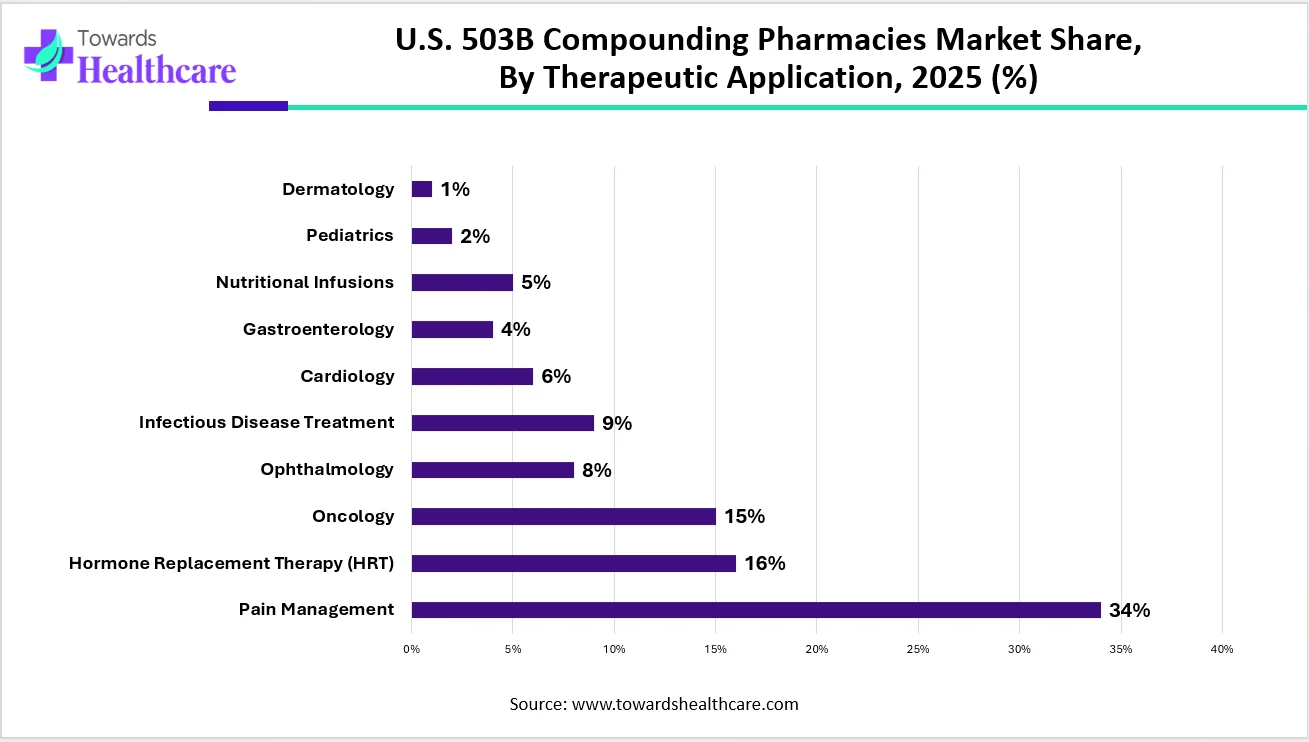
Therapeutic Application Insight

U.S. 503B Compounding Pharmacies Market, By Therapeutic Application, (Pain Management (Dominant)) Segment Dominates by 24% in 2025.

Segments Shares %
Pain Management (Dominant) 24%
Hormone Replacement Therapy (HRT) 14%
Oncology (Fastest Growth) 16%
Ophthalmology 8%
Infectious Disease Treatment 9%
Cardiology 7%
Gastroenterology 6%
Nutritional Infusions 5%
Pediatrics 6%
Dermatology 5%

Explanation

  • Pain Management accounts for 24% and dominates due to high demand for customized therapies and chronic pain treatment.
  • Hormone Replacement Therapy (HRT) contributes 14% and supports long-term hormonal balance treatments.
  • Oncology holds 16% and is the fastest-growing segment due to increasing need for personalized cancer therapies.
  • Ophthalmology represents 8% and serves specialized eye care treatments.
  • Infectious Disease Treatment accounts for 9% and addresses targeted antimicrobial therapies.
  • Cardiology holds 7% and supports customized heart-related treatments.
  • Gastroenterology represents 6% and focuses on digestive system disorders.
  • Nutritional Infusions account for 5% and support supplementation and deficiency management.
  • Pediatrics holds 6% and enables age-specific customized formulations.
  • Dermatology represents 5% and addresses skin-related compounded treatments.

How the Pain Management Segment Dominated the U.S. 503B Compounding Pharmacies Market?

By therapeutic application, the pain management segment contributed the biggest revenue share of the market in 2025, due to the rising prevalence of chronic pain. The Centers for Disease Control and Prevention (CDC) reported that approximately 24.3% of adults were suffering from chronic pain in 2023. Of these, around 8.5% of adults had severe chronic pain, limiting their daily life activities. The increasing demand leads to analgesic shortages. According to the Annual Drug Shortages Report, fentanyl citrate, leucovorin calcium, and lidocaine hydrochloride are some of the most common drugs that have been in shortage for over 3 years.

By therapeutic application, the oncology segment is projected to expand significantly in the market in the coming years. The increasing prevalence of cancer and its complexities potentiate the demand for compounding. Compounding facilitates the delivery of personalized medicines based on a patient’s conditions. It can be a very effective way to provide the needed medications and supplements for cancer treatment.

Compounding Type Insight

Segments Shares %
Batch Compounding (Dominant) 64%
Patient-specific Compounding (High Growth) 36%

Explanation

  • Batch Compounding accounts for 64% and dominates due to efficiency, scalability, and standardized production.
  • Patient-specific Compounding holds 36% and is high-growth due to rising demand for personalized treatments.

Which Compounding Type Segment Led the U.S. 503B Compounding Pharmacies Market?

By compounding type, the batch compounding segment led the market in 2025, due to the increasing demand for critical medications. Batch compounding enables the preparation of bulk medications for multiple patients. This saves time and cost, as well as ensures uniformity in formulation preparation. It also allows pharmacists to prepare drugs for a single patient. Drugs are produced in small to large batches for sale to physicians, healthcare facilities, and other pharmacies.

By compounding type, the patient-specific compounding segment is expected to show the fastest growth in the forecast period. Patient-specific compounding allows pharmacists to provide personalized medicines. Pharmacists can assess a patient’s response and the adverse effects of certain medications on patients. They mix ingredients to meet the unique needs of an individual patient.

Geographical Insights

North America: Leading the Sterile Compounding Revolution

North America is the undisputed leader in the 503B compounding pharmacy space. With a highly advanced healthcare infrastructure, the region depends heavily on these outsourcing facilities to meet the rising demand for ready-to-use, sterile injectables in high-pressure environments like ICUs, emergency rooms, and surgical centers.

  • Over 60% of U.S. hospitals are now sourcing sterile compounds from 503B pharmacies.
  • FDA reported 93 registered outsourcing facilities on the last day of FY2025.

U.S. Trends: Scaling Up Sterile Solutions

Hospitals and clinics across the U.S. are increasingly relying on 503B pharmacies for cancer drugs, anesthesia medications, and antibiotics. Section 503B establishes a regulatory framework under which registered outsourcing facilities can compound and distribute eligible drug products subject to statutory and CGMP requirements.

  • Cancer care, one of the largest consumers of sterile injectables, is pushing facilities to scale up.
  • The growth of ambulatory surgical centers (ASCs) has driven demand for small-dose, high-potency injectable medications.

Canada: Funding Innovation in Sterile Compounding

In Canada, sterile compounding is gaining traction as healthcare facilities look for safer, more consistent drug supply chains. Backed by federal and provincial funding, new guidelines from regulatory bodies are encouraging pharmacies to upgrade compounding capabilities.

  • The Canadian market is focusing on improving patient care through cleanroom expansion and sterility assurance.
  • Increasing investments in hospital pharmacy automation are aligning with global 503B practices.

Top Companies in the 503B Compounding Pharmacies Market

SCA Pharma

SCA Pharma specializes in customized sterile injectable solutions, offering a wide range of compounded medications for hospitals, health systems, and surgery centers across the U.S.

Nephron Pharmaceuticals Corporation

Nephron is known for its large-scale production of sterile injectables and respiratory medications, supplying hospitals and healthcare providers nationwide.

Wells Pharma of Houston LLC

Wells Pharma offers 503B sterile compounded products with a focus on regulatory compliance, safety, and fast turnaround for emergency and surgical care.

Fagron Compounding Pharmacies

Fagron operates U.S. 503B sterile-compounding facilities, including operations in Wichita, Kansas and Boston, Massachusetts.

Olympia Pharmacy

Olympia Pharmacy provides a broad portfolio of 503B compounded injectables, with specializations in wellness, hormone therapy, and aesthetic medicine.

Latest Announcements by Industry Leaders

In July 2025, after receiving the 2025 Pharmacy Compounding Excellence Award, the chief pharmacy officer of BayCare Health System, Mike Magee, stated that, on behalf of BayCare Health System, he was pleased to receive this award. They were able to build one of four health system FDA-approved 503B compounding facilities in the U.S., under the expertise and leadership of their colleague Ken Jozefczyk. With this center, they were able to offer quality treatments to the patients without any drug shortages across the Tampa Bay community.

Recent Developments in U.S. 503B Outsourcing

  • In August 2025, for launching a next-generation, data-driven pharmaceutical manufacturing site in Birmingham, Alabama, a collaboration between SCW and Asteria Health, which is a 503B outsourcing facility, was announced. Moreover, a new milestone will be achieved for the 503B compounding landscape by this collaboration by merging the advanced Digital Factory Platform of SCW with an ambitious vision for operational excellence, growth, and quality of Asteria Health.
  • In February 2025, Nancy Fingerhut was promoted to Vice President of Regulatory Affairs and Quality Assurance, which was announced by Revelation Pharma, which is a foremost nationwide network of 503A and 503B compounding pharmacies. To ensure the highest industry standards in patient safety and compliance, regulatory excellence will be driven by Fingerhut throughout the Revelation Pharma network.

Segments Covered in the Report

By Product Type

  • Sterile Compounded Drugs
    • Parenteral formulations
      • IV solutions
      • IV injections
      • Infusions (nutritional & therapeutic)
    • Ophthalmic sterile products
    • Injectable antibiotics
    • Sterile hormonal formulations
  • Non-sterile Compounded Drugs
    • Oral liquids and suspensions
    • Topical creams and ointments
    • Gels and lotions
    • Capsules & tablets (customized strength/dosage)
    • Lozenges and troches

By Formulation Type

  • Injections & Infusions
    • Single-dose vials
    • Multi-dose vials
    • Pre-filled syringes
    • Nutritional IV therapy (parenteral nutrition)
  • Solutions
    • Oral solutions
    • Topical solutions
    • Ophthalmic solutions
  • Suspensions
    • Oral suspensions
    • Injectable suspensions
    • Pediatric suspensions
  • Creams & Gels
    • Hormonal creams/gels (HRT)
    • Pain relief gels/creams
    • Dermatological creams (eczema, psoriasis, acne)
  • Capsules & Tablets
    • Customized strength oral capsules
    • Compounded tablets for chronic conditions
    • Pediatric dosage forms

By Therapeutic Application

  • Pain Management
    • Chronic pain management
    • Post-surgical pain
    • Neuropathic pain
  • Hormone Replacement Therapy (HRT)
    • Bioidentical hormone therapy
    • Estrogen, progesterone, testosterone formulations
    • Menopausal symptom relief
  • Oncology
    • Chemotherapy supportive care drugs
    • Anti-nausea and pain relief for cancer patients
  • Ophthalmology
    • Eye drops for glaucoma, dry eyes
    • Post-surgical ophthalmic solutions
  • Infectious Disease Treatment
    • Injectable antibiotics
    • Antifungal preparations
    • Antiviral formulations
  • Cardiology
    • Injectable cardiac drugs
    • Oral compounded medications for heart conditions
  • Gastroenterology
    • Digestive enzyme formulations
    • Oral suspensions for GI disorders
  • Nutritional Infusions
    • Parenteral nutrition (PN)
    • Vitamins and micronutrient infusions
  • Pediatrics
    • Pediatric oral solutions
    • Custom dosing formulations
  • Dermatology
    • Topical creams, gels, and ointments
    • Anti-aging and cosmetic compounds
    • Treatment for skin disorders

By Compounding Type

  • Batch Compounding
    • Large-scale sterile compounding for hospitals/clinics
    • Standardized formulations for recurring prescriptions
  • Patient-specific Compounding
    • Customized dose per patient requirement
    • Pediatric formulations with specific dosing
    • Oncology and HRT patient-specific prescriptions

By Country

  • Northeast
  • Midwest
  • South
  • West

FAQ

Finding : The U.S. 503B compounding pharmacies market, valued at USD 1.35 billion in 2026, is projected to reach USD 1.35 billion by 2026 and USD 2.61 billion by 2035, growing at a strong CAGR of 7.63%.

Finding : 503B Outsourcing Facilities function on a far bigger scale than 503A Compounding Pharmacies, which manufacture medications under a doctors prescription.

Finding : FDA, National Institutes of Health, Regulations.gov, NHS, ISPE.

Meet the Team

Payal Rabde

Payal Rabde

Principal Consultant

Payal Rabde is a Healthcare Market Research Analyst at Towards Healthcare Research & Consulting with 4+ years of experience in pharmaceuticals, biotechnology, medical devices, and life sciences.

Learn more about Payal Rabde
Aditi Shivarkar

Aditi Shivarkar LinkedIn

Reviewed By

Aditi Shivarkar is a seasoned professional with over 14 years of experience in healthcare market research. As a content reviewer, Aditi ensures the quality and accuracy of all market insights and data presented by the research team.

Learn more about Aditi Shivarkar