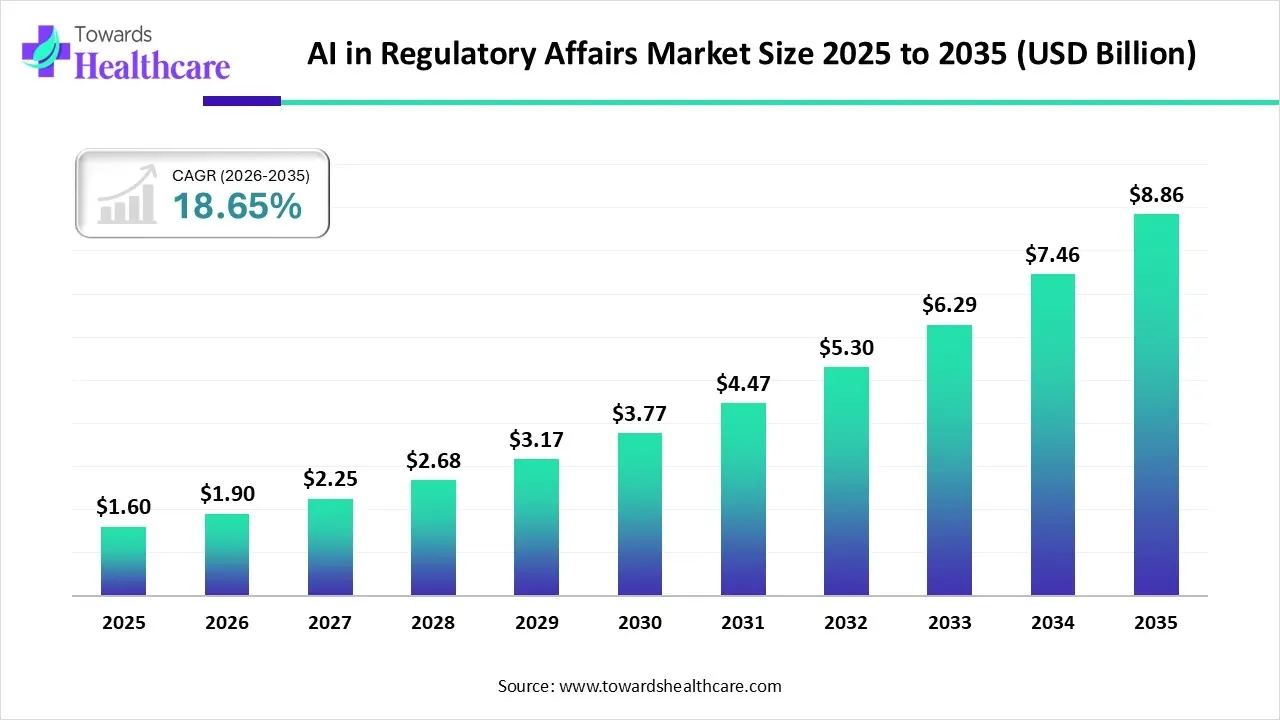
The global AI in regulatory affairs market size is calculated at US$ 1.6 billion in 2025, grew to US$ 1.9 billion in 2026, and is projected to reach around US$ 8.86 billion by 2035. The market is expanding at a CAGR of 18.65% between 2026 and 2035.
The AI in regulatory affairs market is expanding due in large part to the increasing complexity of regulatory submissions and the growing cost pressures in drug development and regulatory operations. Further driving market expansion are technological developments and growing cost pressures in drug development and regulatory operations. The AI in regulatory affairs industry is driven by the growing volume and complexity of international regulatory requirements in the pharmaceutical, biotechnology, and medical device industries.
There is more to integrating AI and machine learning into regulatory affairs than just small efficiency gains. It denotes a paradigm shift in how regulatory bodies function, communicate with health authorities, and deliver strategic value to pharmaceutical development. Every facet of the regulatory function is being transformed by these technologies, from AI-assisted safety signal detection to predictive regulatory intelligence and automated document generation.
| Key Elements | Scope |
| Market Size in 2025 | USD 1.6 Billion |
| Projected Market Size in 2035 | USD 8.86 Billion |
| CAGR (2025 - 2035) | 18.65% |
| Leading Region | North America |
| Market Segmentation | By Component, By Deployment Mode, By Application,By End-use, By Region |
| Top Key Players | IQVIA, Freyr Solutions, DDReg Pharma, RegASK, Deloitte (via its RegAI solution), IBM, Oracle, Microsoft, Google (Alphabet), Tempus AI, Accenture, Wipro, Zenovel, Innoplexus, Workiva, ComplyAdvantage, MetricStream, Viz.ai, ArisGlobal, Veeva Systems |
Why the Software/Platforms Segment Dominated the Market in 2024?
The software/platforms segment led the AI in regulatory affairs market with the largest AI in regulatory affairs market share in 2024. The proper tools and software are essential resources that promote efficiency and guarantee compliance in the complex field of regulatory affairs. These specialized tools, ranging from regulatory intelligence platforms to document management systems, are essential for tracking regulatory changes, maintaining accurate records, and managing the complexity of regulatory submissions.
Services
The services segment is expected to grow at the fastest CAGR in the AI in regulatory affairs market during the forecast period. To ensure that pharmaceutical, biotechnology, and medical device companies comply with all laws and regulations governing the creation, approval, production, and marketing of their products, regulatory affairs services encompass a broad range of professional support activities. These services are essential to the successful registration and lifecycle management of healthcare products in international markets.
Why Cloud-Based Segment Dominated the Market in 2024?
By deployment mode, the cloud-based segment accounted for the largest revenue share of the AI in regulatory affairs market in 2024 and is expected to grow at the fastest CAGR during the forecast period. By improving scalability, flexibility, and cost-efficiency, cloud computing integration in pharmaceutical and life sciences regulatory submissions is revolutionizing drug development. Cloud platforms make it easier to manage data, store clinical trial datasets securely and scalably, and share, integrate, and analyze data to support well-informed decision-making. By facilitating smooth communication and data exchange, these platforms enhance international cooperation between researchers, regulators, and healthcare providers.
On-Premises
The on-premises segment is expected to grow significantly during the forecast period. Policies and regulations, data security, and technological advancements are driving the ongoing growth of the on-premises regulatory management systems market. The need for compliance management systems has been fueled by governments around the world imposing stricter regulations on the production and distribution of drugs.
Which Application Dominated the Market in 2024?
The regulatory intelligence segment accounted for the largest revenue share of the AI in regulatory affairs market in 2024 because of the constantly changing regulatory environment, it can be difficult to make important decisions, such as portfolio expansion and international market entry, in the complex world of biopharmaceuticals and life sciences. In this situation, regulatory intelligence, or RI, is essential. It employs technology to drive growth, increase revenue, and add value while simplifying complexities.
Pharmacovigilance & Safety Reporting
The pharmacovigilance & safety reporting segment is expected to grow at the fastest in the AI in regulatory affairs market CAGR during the forecast period. By supervising pharmaceutical products throughout their whole lifecycle, from development to post-market monitoring, regulatory affairs play a critical role in guaranteeing drug safety and efficacy. Regulatory affairs specialists collaborate closely with health authorities, including the FDA and EMA, to guarantee that pharmaceuticals pass stringent safety requirements and undergo extensive clinical testing before being released onto the market.
Data Migration & Integration
The data migration & integration segment is expected to grow significantly during the forecast period. In the life sciences, data migration and integration play a complex and vital role. The ability to smoothly transfer data across complex ecosystems is a critical success factor as organizations work to innovate, collaborate, and deliver better patient care.
Why did the Pharmaceutical Companies Dominate the Market in 2024?
The pharmaceutical companies segment held the largest AI in regulatory affairs market share in 2024. Of all the industries, the pharmaceutical sector is the most regulated. They are in charge of keeping up with the growing breadth and complexity of regulations and serve as the company's main point of contact with organizations like the FDA. Regulatory affairs specialists in the pharmaceutical sector are knowledgeable about clinical research procedures as well as the legal and regulatory frameworks.
CRO/CDMO
The CRO/CDMO segment is expected to grow at the fastest CAGR during the forecast period. By using their knowledge to guarantee compliance with international health authorities (such as the FDA and EMA) throughout the drug development lifecycle, CROs and CDMOs offer crucial regulatory affairs support.
Biotechnology Companies
The biotechnology companies segment is expected to grow significantly in the AI in regulatory affairs market during the forecast period. Recombinant proteins, cell and gene therapies, and monoclonal antibodies are examples of biotechnology products that are frequently intricate and inventive. In order to move these products from research and development to market approval, regulatory affairs specialists in the biotech industry are essential in navigating the constantly changing regulatory environment.

North America dominated the AI in regulatory affairs market in 2024. Market expansion is fueled by the complexity and volume of regulatory requirements from organizations like Health Canada and the U.S. FDA. Furthermore, flexible, scalable regulatory solutions are required due to the expansion of clinical trials and the advancement of personalized medicine. AI and data analytics integration enhances compliance management and real-time monitoring. Furthermore, the need for economical regulatory function outsourcing speeds up market expansion.
Regulating America: OIRA's Oversight and FDA's Health
OIRA is the central body of the U.S. government that oversees the coordination of federal privacy policy, the approval of government information gathering, the establishment of government statistical procedures, and the review of Executive Branch regulations. Furthermore, the U.S. Food and Drug Administration (FDA) is a health authority that oversees the use of experimental medications in the U.S.
For instance,
U.S. Market Trends
U.S. consists of large pharmaceuticals and biotechnology industries, which have increased the use of AI in regulatory affairs operations. High regulatory complexity and growth in investments in AI have also increased their adoption and innovation. The expansion of regulatory software companies and regulatory complexities have also increased their advancements.
Canada Market Trends
The presence of well-established pharma, biotech, and AI research centres increases the adoption of AI solutions to improve regulatory efficiency across Canada. Growing government support and clinical activities are also encouraging their adoption. Increasing investments are also driving their utilization, promoting healthcare modernization.
Asia Pacific is estimated to host the fastest-growing AI in regulatory affairs market during the forecast period, driven by recent regulatory developments and the rapidly growing number of clinical studies and trials. The market's expansion has been fueled by the region's massive cost-cutting initiative. This region's enormous supply of high-quality labor has greatly expanded the market. Another factor contributing to the market expansion is the rapidly growing geriatric population.
Drug Approval in China: Regulatory Affairs and Strategic Insights
China has the second-largest pharmaceutical market in the world, thanks to increased access to new medications, changing laws, and rising public demand for pharmaceuticals. Drugs, medical devices, and traditional medicines are regulated by key agencies such as the Ministry of Human Resources and Social Security (MOHRSS), the National Medical Products Administration (NMPA), and the National Health Commission (NHC).
India Market Trends
India is experiencing rapid expansion due to growing pharmaceutical industries. Evolving regulatory requirements and increasing complexities are also driving the demand for AI solutions. Expanding government initiatives and strong IT expertise are also increasing their use.
Europe is expected to grow at a significant CAGR in the AI in regulatory affairs market during the forecast period, driven by the region's growing need for CROs, the presence of major pharmaceutical companies, and ongoing drug discoveries. Several CROs focused on drug discovery have set up centers in countries such as the UK, Germany, and France, taking advantage of these nations' strong research infrastructure and highly qualified labor force.
MHRA Marketing Authorisation: UK Regulatory Approvals
According to the GOV.IN the UK, the Medicines and Healthcare Products Regulatory Agency (MHRA) oversees regulatory matters. This entails overseeing applications for clinical trials, variations, and marketing authorizations, as well as making sure goods like pharmaceuticals, medical equipment, and blood components adhere to safety, quality, and efficacy requirements.
The presence of pharmaceutical companies and well-established CROs are also driving the demand for AI solutions for regulatory processes. Growing government initiatives and investments are also increasing their use to streamline regulatory submission and compliance.
Germany Market Trends
Stringent EU regulatory requirements drive the demand for AI technologies across Germany. The presence of pharmaceutical, medical device, and biotechnology industries also increases the demand for digital solutions. The focus on improving regulatory accuracy and efficiency is also increasing their use.
South America is expected to grow significantly in the AI in regulatory affairs market during the forecast period. As South American businesses use digital platforms to automate compliance, the market for AI in regulatory affairs is growing. Effective regulatory support is necessary for expanding clinical trials and introducing new products. AI-driven tools are used by outsourcing partners to improve documentation accuracy, expedite submissions, and monitor risks in real time.
Brazil Market Trends
Brazil's market is driven by expanding AI adoption in sectors like healthcare and finance. The nation's new Brazilian Artificial Intelligence Plan supports AI research and development. Proposed legislation on AI governance, including risk assessment, is creating a formalized regulatory framework for sophisticated AI tools.
Argentina Market Trends
Argentina is anticipated to show lucrative growth during the upcoming years, due to expanding pharmaceutical and biotechnology industries. Increasing clinical research and research capabilities are also increasing the adoption of AI for regulatory applications. New collaborations and investments are also supporting their use, propelling healthcare digitalization.
The Middle East and Africa are expected to grow at a lucrative CAGR in the AI in regulatory affairs market during the forecast period. The Middle East and Africa (MEA) region is experiencing strong growth, fueled by the rising complexity of advanced biologics and medical devices. Companies are increasingly outsourcing regulatory functions, leading to the rapid adoption of AI-enabled technologies. This shift supports streamlined submissions and proactive compliance monitoring.
GCC Pushes Smart Regulation for Growth
Gulf Cooperation Council (GCC) countries, notably Saudi Arabia and the UAE, see high demand for AI-driven compliance solutions. Investments in smart city initiatives and digital transformation are critical drivers. AI tools help automate processes like dossier compilation and ensure timely, efficient regulatory approvals for expanding product portfolios.
UAE Market Trends
UAE consists of advanced healthcare and life science industries that utilize AI to comply with regulatory requirements. Growing R&D activities and investments are also fueling the adoption of AI and other digital solutions. Increasing focus on smart healthcare initiatives is also driving their demand.

| Company | Offerings | Contributions | Highlights | Impact |
| Freyr Solutions | AI submissions automation | Speeds approvals using smart workflows globally | Expanding global support rapidly | Enhances compliance efficiency overall |
| DDReg Pharma | Automated dossier review tools | Improves accuracy across regulatory tasks significantly | Strong regional presence growing | Reduces review timelines effectively |
| RegASK | AI monitoring dashboards | Delivers timely global intelligence consistently | Multilingual insights driving clarity | Strengthens regulatory foresight proactively |
| Deloitte RegAI | Intelligent compliance engines | Modernizes enterprise regulatory processes comprehensively | Integrated ecosystem enabling trust | Supports scalable governance sustainably |
| IBM | NLP-driven regulatory analytics | Supports data-led decisions across industries strategically | Broad automation capabilities are advancing | Improves operational resilience holistically today |
Company Overview:
Corporate Information:
History and Background:
Key Milestones/Timeline:
Business Overview:
Business Segments/Divisions:
Geographic Presence:
Key Offerings:
End-Use Industries Served:
Key Developments and Strategic Initiatives:
Distribution Channel Strategy:
Technological Capabilities/R&D Focus:
Competitive Positioning:
SWOT Analysis:
Recent News and Updates:
Company Overview:
Corporate Information:
History and Background:
Key Milestones/Timeline:
Business Overview:
Business Segments/Divisions:
Geographic Presence:
Key Offerings:
End-Use Industries Served:
Key Developments and Strategic Initiatives:
Distribution Channel Strategy:
Technological Capabilities/R&D Focus:
Competitive Positioning:
SWOT Analysis:
Recent News and Updates:
By Component
By Deployment Mode
By Application
By End-use
By Region




Principal Consultant
Payal Rabde is a Healthcare Market Research Analyst at Towards Healthcare Research & Consulting with 4+ years of experience in pharmaceuticals, biotechnology, medical devices, and life sciences.
Learn more about Payal Rabde

Reviewed By
Aditi Shivarkar is a seasoned professional with over 14 years of experience in healthcare market research. As a content reviewer, Aditi ensures the quality and accuracy of all market insights and data presented by the research team.
Learn more about Aditi Shivarkar